There is no national point system: the number of points on your license, and the number that matters, depend on your state’s own schedule, its window and the lines its statute names. This checker takes up to four tickets and, for 12 states whose rules we read in official text, shows the points the state’s schedule gives each one, your highest total in any 12, 24 and 36 months, and whether those totals reach each line the statute names, with the statute’s own words for what happens there. It shows the rule as written. The DMV’s letter controls, and only your state’s driving record shows your real total. More on how points work across the states is in our points and records guide.
This page is general information about the law, not legal advice and not a substitute for the advice of an attorney. Traffic, license and SR-22 rules vary by state and change. The court’s or the DMV’s own letter controls.
How to use the checker
- Pick the state that issued your license. A conviction from another state is given whatever effect your home state’s own law provides, not the other state’s rules (Driver License Compact, Art. IV(b), as Virginia adopted it in Va. Code 46.2-483, read 12 Nov 2026). Our page on tickets from another state explains the compacts.
- Pick your age and license type. Some states have their own lines for drivers under 18 or on a provisional or junior license, and Colorado has its own lines for drivers 18 to 20.
- Enter each ticket that ended in a conviction, one row per separate occasion: the violation, the posted limit, how many mph over (speeding only) and how many months ago. Count the months from the date your state uses; the result names it. Leave out a ticket that was dismissed, or one a course kept off your record (California’s traffic school, Florida’s Basic Driver Improvement election, Texas’s driving safety course).
- Tick the course box only if you finished the state’s point-reduction course after these tickets, in a state that gives a credit. Tick the Colorado box only if every Colorado ticket was a penalty assessment paid on time. A Colorado driver aged 18 to 20 should enter only tickets from after the 18th birthday, because the checker tests Colorado’s 14-points-since-18 line against the highest total in any 36 months.
The result shows, for each ticket, the points on the state’s schedule. That is the schedule’s value for that violation, not a promise of what your record will show: a court can convict of a different charge, and some states assign points to violations this checker doesn’t list. Then come your highest totals in any 12, 24 and 36 months, the course credit it took off, and up to three lines from your state’s statute, each with “reaches it” or “does not reach it” and the statute’s words for what follows. Under-18, provisional and junior drivers get one more line. The last line names the sections, the date we read them and which date the state counts from.
“Reaches it” means your entries reach the number the statute names. It does not mean a suspension will follow, or when. Most of these statutes let the agency act (“may”), send a notice first, or offer a hearing, and some set a range (“not more than 30 days”) instead of a fixed length. The agency’s own letter says what it is doing and by when. The checker never gives a date.

Worked example: the defaults
This page is general information about the law, not legal advice and not a substitute for the advice of an attorney. Traffic, license and SR-22 rules vary by state and change. The court’s or the DMV’s own letter controls.
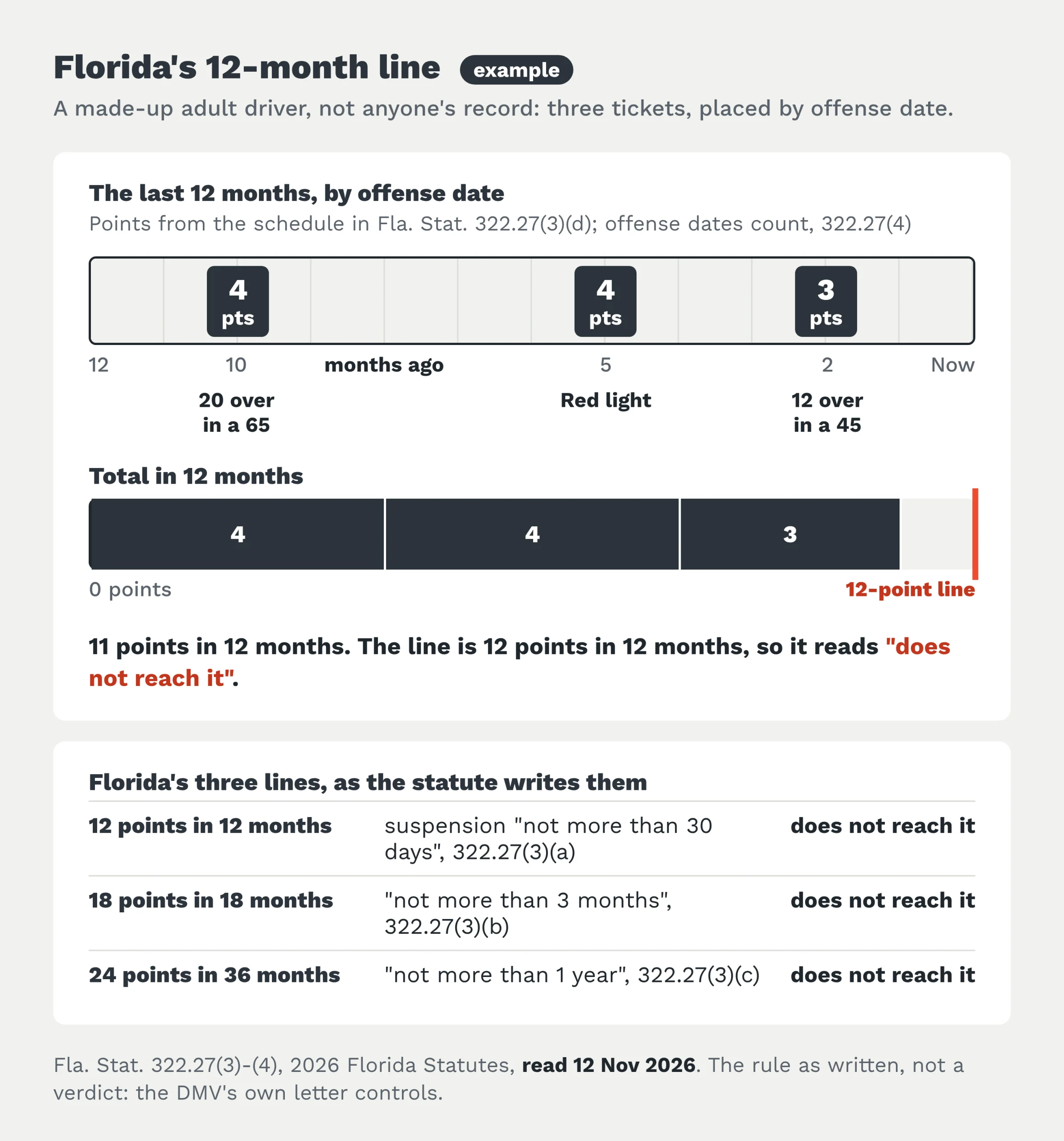
The checker opens on a made-up example, not anyone’s record: an adult Florida driver with three convictions, for 12 mph over in a 45 zone two months ago, a red light five months ago and 20 mph over in a 65 zone ten months ago. Florida’s schedule in Fla. Stat. 322.27(3)(d) (2026 Florida Statutes, read 12 Nov 2026) gives:
| Ticket | Schedule line | Points |
|---|---|---|
| 12 over, 2 months ago | Unlawful speed not in excess of 15 mph, (d)5.a | 3 |
| Red light, 5 months ago | Traffic control signal device, (d)6 | 4 |
| 20 over, 10 months ago | Unlawful speed in excess of 15 mph, (d)5.b | 4 |
| Total | All three offenses fall within 12 months | 11 |
Florida counts by offense date (322.27(4)). Its three lines are 12 points in 12 months (suspension “for not more than 30 days”), 18 in 18 months (“not more than 3 months”) and 24 in 36 months (“not more than 1 year”). Eleven points in 12 months does not reach any of them, so all three lines read “does not reach it”. If the 20-over ticket had been 18 months ago instead, the 12-month total would be 7 (the two newer tickets) and the 18-month total still 11, because the oldest and newest tickets would then be 16 months apart.
The 12 states in the checker
Each state is in the checker because its schedule, its lines and its window were read in the statute or rule itself. The table is a summary; each fold-out below it lists the schedule values the checker uses. The full 51-row table is on our points and suspension rules by state page.
| State | Counts | Lines in the checker | Counts from |
|---|---|---|---|
| California | Points | 4 in 12, 6 in 24, 8 in 36 months | Not named in 12810.5 |
| Colorado | Points | Adult 12 in 12 or 18 in 24 months | Violation date |
| Florida | Points | 12 in 12, 18 in 18, 24 in 36 months | Offense date |
| Maryland | Points | 5, 8 and 12 in 2 years | Violation date |
| Nevada | Demerit points | 12 in 12 months | Conviction date |
| New York | Points | 11 in 24, 9 speeding in 24, 7 in 24 months | Violation date |
| North Carolina | Points | 12 in 3 years | 3-year period |
| Ohio | Points | 12 in 2 years; warning above 5 | First conviction |
| South Carolina | Weighted points | 12 points, 4 bands | Latest violation |
| Texas | Convictions | 4 in 12, 7 in 24 months | 12 consecutive months |
| Virginia | Demerit points | 18 in 12, 24 in 24; clinic 12 in 12, 18 in 24 | Offense date |
| Washington | Occasions | 3 in 1 year, 4 in 2 years; notice 2 or 3 | Offense date |
California: Vehicle Code 12810, 12810.5 and 12814.6
Schedule (Veh. Code 12810, read 12 Nov 2026): reckless driving 2 points (12810(c)); driving over 100 mph under 22348(b) 2 points (12810(d)(1)); “any other traffic conviction involving the safe operation of a motor vehicle” 1 point (12810(f)), which covers the other violations in the checker. A hand-held phone point applies only to a repeat conviction within 36 months (12810.3), so leave a first phone ticket out.
Lines (12810.5(a)): a driver with “four or more points in 12 months, six or more points in 24 months, or eight or more points in 36 months shall be prima facie presumed to be a negligent operator”. The section names no suspension length; DMV acts after notice, and a hearing can be asked for. Section 12810.5(b) sets different counts for some Class A and B drivers, which the checker doesn’t apply. Provisional license (12814.6(g)): 2 points in 12 months, a 30-day restriction to driving with a licensed parent, spouse, guardian or other licensed driver 25 or older; 3 points in 12 months, a 6-month suspension and a year of probation. State page: California points and traffic school.
Colorado: C.R.S. 42-2-127 and 42-2-132
Schedule (C.R.S. 42-2-127(5), Colorado Revised Statutes 2026, read 12 Nov 2026): speeding 1-4 over 0, 5-9 over 1, 10-19 over 4, 20-39 over 6, 40 or more over 12 (over the reasonable and prudent speed, or over the 75 mph maximum); failure to observe a traffic sign or signal 4; following too closely 4; failure to yield 3; reckless driving 8; failure to stop for a school bus 6; moving violations not listed, other than a class B traffic infraction, 3 (127(5)(r)). Paid on time (127(5.5)): a penalty assessment paid by its due date cuts a 3-or-more-point violation by 2 and a 2-point one by 1. The checker makes no cut for reckless driving, passing a stopped school bus or speeding 25 mph or more over: none of these is on the penalty-assessment schedule in C.R.S. 42-4-1701(4), so (5.5) can’t reach them.
Lines (127(1)(a)): adults 12 points in any 12 consecutive months or 18 in any 24; drivers 18 to 20, 9 in 12, 12 in 24, or 14 for violations after 18 (the checker tests the 14 against your highest 36-month total, so enter only tickets from after 18); drivers under 18, more than 5 in 12 months or more than 6 before 18. Windows run by violation date (127(2)(a)). No suspension until a hearing has been held or missed (127(1)(d)), and the department “shall not suspend … for a period of more than one year” (42-2-132(1)); the length is set at the hearing. Chauffeurs on duty have higher lines (16 in 1 year, 24 in 2, 28 in 4), which the checker doesn’t apply. State page: Colorado points.
Florida: Fla. Stat. 322.27 and 322.161
Schedule (322.27(3)(d), 2026 Florida Statutes, read 12 Nov 2026): speeding not over 15 mph 3, over 15 mph 4; traffic control signal device 4; reckless 4; passing a stopped school bus 4 (6 with serious injury or death); all other moving violations 3, which covers following too closely and failure to yield. Camera tickets carry no points. Stop-sign tickets are left out of the checker: depending on the charge they fall under the signal-device line (4) or the other-violations line (3), and only the citation shows which.
Lines (322.27(3)(a)-(c)): 12 points in 12 months, “not more than 30 days”; 18 in 18 months, “not more than 3 months”; 24 in 36 months, “not more than 1 year”. Offense dates count (322.27(4)). Ages 15 to 17 (322.161): a Class E licensee aged 15 through 17 with 6 or more points in 12 months gets a license restricted to business purposes only, for at least 1 year, extended 90 days for each further point; the restriction is withdrawn at the 18th birthday if no other grounds exist (322.161(1)(c)). State page: Florida points, suspension and BDI.
Maryland: Transportation 16-402 and 16-404
Schedule (Transp. 16-402(a), read 12 Nov 2026): any moving violation not listed and not contributing to a crash 1; following too closely 2; 10 or more over 2; red signal 2; failing to stop for a school vehicle 3; 20 or more over a posted 65 mph limit 5; reckless 6; 30 or more over 6. Points count “as of the date of violation”, and only the highest charge from one occasion counts (16-402(b)). Stop-sign and failure-to-yield tickets are left out: the schedule lists several sections by number that we have not matched to those charges.
Lines (16-404(a), any 2-year period): 3 points, a warning letter; 5, a driver improvement program (a professional driver with a class A, B or C license can be called in at 8); 8, suspension; 12, revocation. A first suspension “may not be for less than 2 days nor more than 30 days”, later ones 15 to 90 days (16-404(c)); the revocation length was not read. The notice gives 10 days, not counting weekends and legal holidays, to ask for a hearing (16-404(b)(2)). Provisional, under 18 (16-404(d)): 5 or more points in 12 months, a 6-month suspension the first time, 1 year after that. State page: Maryland points.
Nevada: NRS 483.473 to 483.475, NAC 483.500 to 483.510
Schedule (NAC 483.510, read 11 to 12 Nov 2026): speeding 1-10 over 1, 11-20 over 2, 21-30 over 3, 31-40 over 4, 41 or more over 5; red light, stop sign, failure to yield, following too closely and school bus 4; reckless 8. Other moving violations are left out of the checker. Points drop off 12 months after the conviction date (NAC 483.500), so enter months from the conviction.
Line (NRS 483.475): 12 or more points in 12 months, a 6-month suspension the first time (1 year for a second within 3 years). Nevada’s under-18 rules are not in the checker. Course: up to 3 points off, only after a DMV notice at 3 to 11 points, once in 12 months, and not after reaching 12 (483.475(1)); the checker gives no credit at 12 or more. State page: Nevada demerit points.
New York: 15 NYCRR 131.3 to 131.5 and VTL 510-c
Schedule (15 NYCRR 131.3, as amended and enforceable from 16 Feb 2026 under DMV memo P2/M1 2026; rule read 12 Nov 2026 on the official NYCRR site, current through 30 Sep 2025): speeding 1-10 over 3, 11-20 over 4, 21-30 over 6, 31-40 over 8, more than 40 over 11; red light, stop sign and failure to yield 3; following too closely 4; reckless 5; passing a stopped school bus 8 (5 before 16 Feb 2026); other moving violations 2, though some listed ones carry more (failure to exercise due care 5 and speeding in a work zone 8 for violations from 16 Feb 2026). Values go by violation date (131.3(c)).
Lines (131.4): 11 or more points in 24 months, or 9 or more points from speeding in 24 months, lets DMV hold “a formal hearing … at which suspension or revocation action may be taken” (131.4(c)); 7 to 10 points, DMV may require a driver improvement clinic (131.4(b)). The rule sets no suspension length, so the checker shows none. The 24-month look-back started 16 Feb 2026 (it was 18 months), so the checker computes New York only when every ticket is under 9 months old; an older ticket shows “not confirmed”. PIRP (131.5): up to 4 points off the count, for violations in the 18 months before the course, once in 18 months; the checker takes it off the 11-point line only, and whether it also reduces the speeding-points line is not confirmed. Junior license, class DJ or MJ (VTL 510-c, read 12 Nov 2026): a 60-day suspension for one “serious traffic violation” (including speeding 10 or more over, red lights, stop signs, passing a school bus and reckless driving) or for a second conviction of any other kind. A probationary license (the first 6 months, VTL 510-b, read 12 Nov 2026) has its own 60-day rule, which the checker doesn’t apply. State page: New York points and suspension.
North Carolina: G.S. 20-16
Schedule (G.S. 20-16(c), read 11 Nov 2026): speeding in excess of 55 mph 3 (the checker adds the limit and the mph over); speeding at 55 or under, as an other moving violation, 2; red light and stop sign 3; following too closely and reckless 4; passing a stopped school bus 5; other moving violations 2. Failure to yield is left out.
Line (20-16(a)(5), (c)): 12 points in 3 years (8 within 3 years after a reinstatement, which the checker can’t see); the first suspension is “not more than 60 days”, the second not more than 6 months, later ones not more than 1 year. Clinic: the DMV “may” offer a driver with 7 or more points, or 4 or more in the 3 years after a reinstatement, its driver improvement clinic, which takes 3 points off, once in 5 years (G.S. 20-16(c), read 12 Nov 2026). Some single speeding convictions carry their own suspension under other North Carolina sections, which the checker does not test. The provisional-license rules for drivers under 18 are not in the checker. State page: North Carolina points and PJCs.
Ohio: R.C. 4510.036 and 4510.037
Schedule (R.C. 4510.036, read 11 to 12 Nov 2026): speeding 30 or more over 4; more than 10 over where the limit is 55 or more, 2; more than 5 over where it is under 55, 2; less, 0; reckless 4; other moving violations 2. Red-light, stop-sign, following, yield and school-bus tickets are left out until the schedule lines for them are re-read.
Lines (4510.037): 12 or more points within 2 years, counted from the first conviction, a class D suspension, which is 6 months (4510.037(B), 4510.02); above 5 points, a warning letter. Remedial course: a 2-point credit, once in 3 years and 5 times in a lifetime. Ohio’s under-18 rule is not in the checker. State page: Ohio points, suspension and SR-22.
South Carolina: S.C. Code 56-1-720 to 56-1-770
Schedule (56-1-720, read 12 Nov 2026): speeding no more than 10 over 2, more than 10 but less than 25 over 4, 25 or more over 6; disobeying an official traffic control device (red lights and stop signs) 4; failing to yield 4; following too closely 4; reckless 6; passing a stopped school bus 6. The schedule has no catch-all line, so other moving violations are left out.
How it counts (56-1-750): points from the 12 months up to and including the latest violation count in full, those from 12 to 24 months before it count half, older ones not at all. Line (56-1-740(A)): 12 points; the department “may suspend, for not more than six months”: 12-15 points three months, 16-17 four, 18-19 five, 20 or more six. Violations used for one suspension are not counted again (56-1-760). Course (56-1-770): 4 points off, once in 3 years. South Carolina’s under-18 rules are not in the checker. State page: South Carolina points.
Texas: Transportation Code 521.292 and 521.293
No points since 1 Sep 2019. Transp. Code 521.292(b) (read 12 Nov 2026) makes a “habitual violator” of a person with “four or more convictions that arise out of different transactions in 12 consecutive months, or seven or more convictions that arise out of different transactions in 24 months”, for moving violations of any state, with seat-belt and some truck-weight offenses left out. The checker counts each row as 1. If no hearing is requested, the suspension is 90 days (521.293). Under 18 (521.292(a)(8)): two or more moving violations committed within a 12-month period. State page: Texas convictions and the driving safety course.
Virginia: Va. Code 46.2-492 to 46.2-506 and 46.2-334.01
Schedule (46.2-492(D), read 12 Nov 2026): speeding 1-9 over 3, 10-19 over 4, 20 or more over 6; failure to yield 4; following too closely 4; reckless 6; only the highest offense from one occasion counts (46.2-492(E)). The statute leaves other values, including red lights, stop signs and school buses, to the Commissioner, so those are left out. Points are valid 2 years from the offense date (46.2-493).
Lines: 18 points within any 12 consecutive months or 24 within any 24: the Commissioner suspends for 90 days “and thereafter until” a driver improvement clinic is completed, or requires 9 months in the Intelligent Speed Assistance Program plus a clinic, the driver choosing within 30 days of the notice (46.2-506(B)); 12 in 12 or 18 in 24, for drivers 18 or older, a clinic (46.2-498(A)). Safe driving points (one per clean calendar year, up to 5, 46.2-494) offset demerits; the checker can’t see them. Voluntary clinic: 5 points off or a premium reduction, not both, once in 2 years (46.2-498(D)). Under 18 (46.2-334.01(A)): for offenses committed before 18 (convictions up to age 19 count), a first demerit conviction, a clinic; a second, 90 days; a third, revocation for 1 year or until 18, whichever is longer. State page: Virginia demerit points.
Washington: RCW 46.20.2892
No points. RCW 46.20.2892 (version in effect from 1 Apr 2026, read 12 Nov 2026) counts the occasions on which a person “committed a traffic infraction for a moving violation”; several infractions from one stop are one occasion. Three or more occasions within a year, or four or more within two years: a 60-day suspension and a year of probation, with a safe driving course before reinstatement; the course can end the suspension early, once every 5 years. Two in a year or three in two years: a notice that one more will mean suspension. Reckless driving is a crime with its own suspension rule (RCW 46.61.500), not an infraction, so it is left out. Washington’s rules for intermediate (under-18) licenses are not in the checker. State page: Washington moving violations.
The window is not how long a ticket shows
The checker deals with one kind of “how long”: the window in which points count toward a line, such as Florida’s 12, 18 and 36 months. Two other kinds are separate. How long a conviction shows on your record, for insurers and employers to see, is set by other sections: California, for example, discloses most violations for 3 years and two-point ones for 7 (Veh. Code 1808(b), read 12 Nov 2026). Decay rules change the count itself: South Carolina halves points after 12 months, and Nevada drops them after 12. Our page on how long points stay on your record keeps the three apart, state by state.
What the course box does
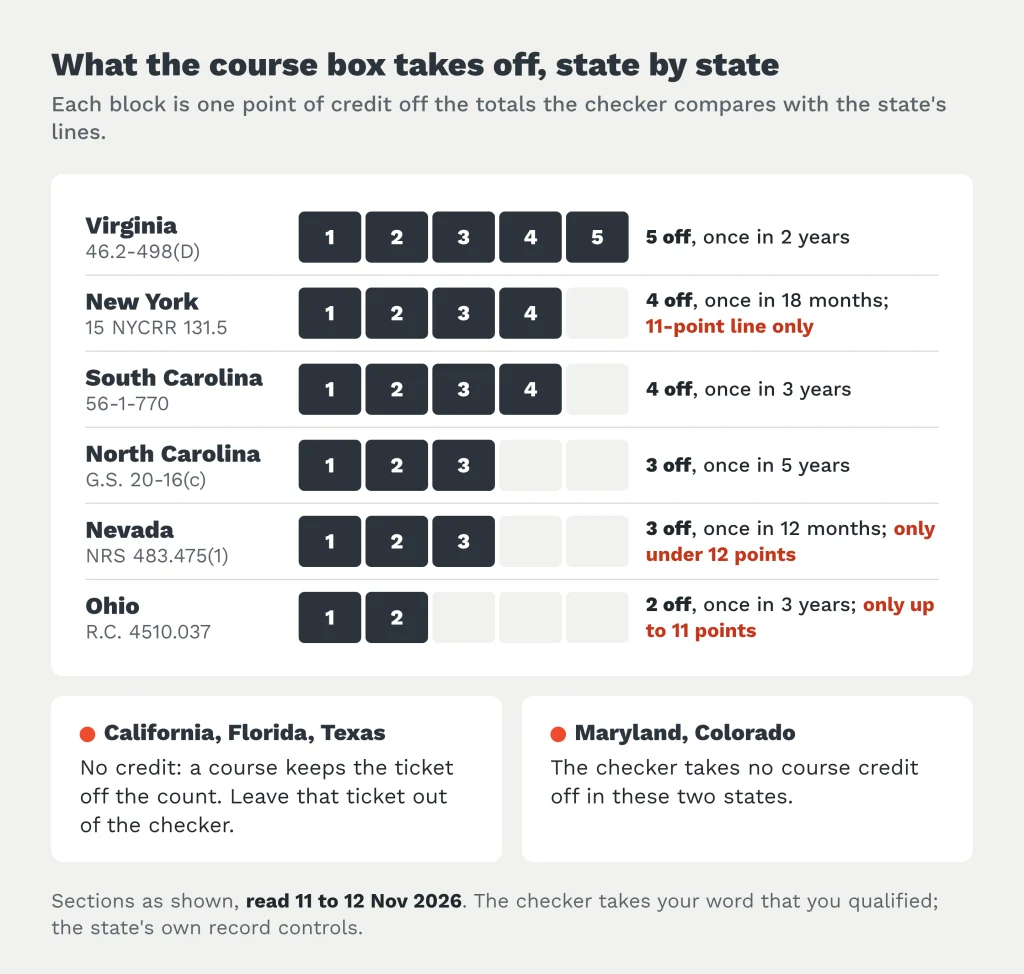
Ticking the box takes the state’s credit off the totals used for its lines: New York 4 (PIRP, 131.5; the checker applies it to the 11-point line only), North Carolina 3, Nevada 3 (only under 12 points), Ohio 2 (only up to 11 points), South Carolina 4 and Virginia 5. Each credit has its own limit (once in 12 months in Nevada, 18 months in New York, 2 years in Virginia, 3 years in Ohio and South Carolina, 5 years in North Carolina), and the checker takes your word that you qualified. California, Florida and Texas work differently: a course keeps a ticket off the count, so leave that ticket out. The checker takes no course credit off in Maryland or Colorado. Colorado’s driving-improvement course waiver (C.R.S. 42-2-127.1) takes effect on 1 Jan 2027, or sooner if the department adopts its rules first; the 2026 statutes say the revisor had not been told of any rules. Our traffic school by state page has each rule and who is barred. A CDL or CLP holder’s conviction can’t be masked or deferred by any course, in any vehicle (49 CFR 384.226).
CDL holders: the federal line
Choosing “CDL holder” shows your state’s ordinary lines. The federal disqualification rule sits on top of them and is the same in every state: under 49 CFR 383.51(c) (eCFR up to date as of 9 Nov 2026), a second conviction for a serious traffic violation in a separate incident within a 3-year period disqualifies a CDL or CLP holder from commercial vehicles for 60 days, and a third or later for 120 days. Serious violations include speeding 15 mph or more over, reckless driving, improper or erratic lane changes and following too closely. In a commercial vehicle every such conviction counts; in your own car it counts only “if the conviction results in the revocation, cancellation, or suspension” of your license. Our CDL tickets page covers major offenses, the employer notice within 30 days (383.31) and the end of self-reporting to the licensing state on 22 Jul 2026.
What the checker can’t see
- Your actual driving record, including convictions you have forgotten or that came in from another state.
- A court’s own order: a suspension a judge imposes, a reduced or amended charge, supervision, deferral or a prayer for judgment continued.
- A ticket still pending. Points come with a conviction, not with the ticket.
- Earlier suspensions, which change later lengths in Maryland, Nevada, North Carolina and South Carolina, and the points a state stops counting after a suspension.
- A DMV hearing, a warning letter already sent, probation already running, or a course the DMV has not credited yet.
- Under-18 and provisional rules in states where the result says “not in the checker”.
- Violations outside its eight violation types, and every rule for DUI, which has its own suspensions.
States not in the checker yet
Three launch states are read but not in the checker. Illinois acts only after three or more moving-violation convictions for offenses committed within any 12 months and then applies a points table whose bands depend on earlier suspensions (625 ILCS 5/6-206(a)(2); 92 Ill. Adm. Code 1040.30), a structure the checker’s form can’t hold. Pennsylvania (75 Pa.C.S. 1545) and New Jersey (MVC’s schedule) take 3 points off for each 12 months without a violation, a running balance that depends on the order of every ticket. Each has its own state page. The other 35 states and DC are summarized in the 51-row table with their status; a state joins the checker once its schedule, lines and window are read in full.
A claim you may see elsewhere
Many pages still say New York acts at “11 points in 18 months”. We checked it against the rule. Since 16 Feb 2026 the look-back is 24 months, and 9 points from speeding alone can also lead to a hearing (15 NYCRR 131.4(c); DMV memo P2/M1 2026). The rule sets no suspension length at all. Pages that give “the” number of points for a speeding ticket miss the same point from the other side, as our guide to how license points work shows: the same 12 mph over is 1 point in California, 3 in Florida, 4 in New York and Virginia, and none at all in Texas, which counts convictions instead and has had no point system since 1 Sep 2019.
Your next step
The checker can tell you what the statute says about the entries you typed. Your record and the agency’s letter tell you what is actually happening. If you have a letter from the DMV, BMV, MVA, DOL or DPS, it states the action, the dates and how to ask for a hearing, and those control. If you don’t know your real total, order your own driving record or points summary from the state; our page on checking your license status, points and driving record links each state’s official page. If a ticket is still open, the court’s own website and self-help center explain the choices and their deadlines. For what each kind of suspension means and how a license comes back, see why licenses get suspended.
Statutes and rules checked on 12 November 2026: Cal. Veh. Code 12810, 12810.5 and 12814.6 (leginfo); C.R.S. 42-2-127 and 42-2-132 (Colorado Revised Statutes 2026); Fla. Stat. 322.27 and 322.161 (2026 Florida Statutes); Md. Transp. 16-402 and 16-404; S.C. Code 56-1-720 to 56-1-770; Tex. Transp. Code 521.292 and 521.293; Va. Code 46.2-483, 46.2-492 to 46.2-506 and 46.2-334.01; Cal. Veh. Code 1808; C.R.S. 42-2-127.1; RCW 46.20.2892 (version from 1 Apr 2026); VTL 510-b and 510-c; New York DMV memo P2/M1 2026; 49 CFR 383.51 (eCFR up to date as of 9 Nov 2026). 15 NYCRR 131.3-131.5 read 12 Nov 2026 (official text current through 30 Sep 2025). Ohio R.C. 4510.036-.037, N.C. G.S. 20-16 and Nevada NRS 483.475 and NAC 483.500-.510 were read again in official text on 12 Nov 2026.
Formulas and sources
- State chosen: Reader's choice, no outside figure
- Ticket 1 speeding poin: State table
- Ticket 2 speeding poin: State table
- Ticket 3 speeding poin: State table
- Ticket 4 speeding poin: State table
- Points by type, digits: State table
- Ticket 1: schedule poi: State table
- Ticket 2: schedule poi: State table
- Ticket 3: schedule poi: State table
- Ticket 4: schedule poi: State table
- Highest total in any 1: Your entries
- Highest total in any 1: Your entries
- Highest total in any 2: Your entries
- Highest total in any 3: Your entries
- New York speeding poin: State table
- Tickets 9 or more mont: Your entries
- Number of tickets ente: Your entries
- New York junior seriou: State table
- Course credit taken of: State table
- Months since the lates: Your entries
- South Carolina weighte: State table
- First line: State table
- Second line: State table
- Third line: State table
- Under-18 or provisiona: State table
Sources
- California: Veh. Code 12810
- California: Veh. Code 12810.5
- California: Veh. Code 12814.6
- California: Veh. Code 1808
- Colorado: C.R.S. 42-2-127, 42-2-132 (Colorado Revised Statutes 2026)
- Colorado: C.R.S. 42-2-127.1 (Colorado Revised Statutes 2026)
- Florida: Fla. Stat. 322.27 (2026 Florida Statutes)
- Florida: Fla. Stat. 322.161 (2026 Florida Statutes)
- Maryland: Transp. 16-402
- Maryland: Transp. 16-404
- Nevada: NRS chapter 483
- Nevada: NAC chapter 483
- New York: DMV memo P2/M1 2026 on 15 NYCRR 131.3-131.4
- New York: VTL 510-c
- New York: VTL 510-b
- North Carolina: G.S. 20-16
- Ohio: R.C. 4510.036
- Ohio: R.C. 4510.037
- South Carolina: S.C. Code title 56, chapter 1
- Texas: Transp. Code chapter 521
- Virginia: Va. Code 46.2-492
- Virginia: Va. Code 46.2-506
- Virginia: Va. Code 46.2-498
- Virginia: Va. Code 46.2-334.01
- Virginia: Va. Code 46.2-483 (Driver License Compact)
- Washington: RCW 46.20.2892
- 49 CFR 383.51 (eCFR, up to date as of 9 Nov 2026)
- Virginia: Va. Code 46.2-493
- Virginia: Va. Code 46.2-494
- 49 CFR 384.226 (eCFR)