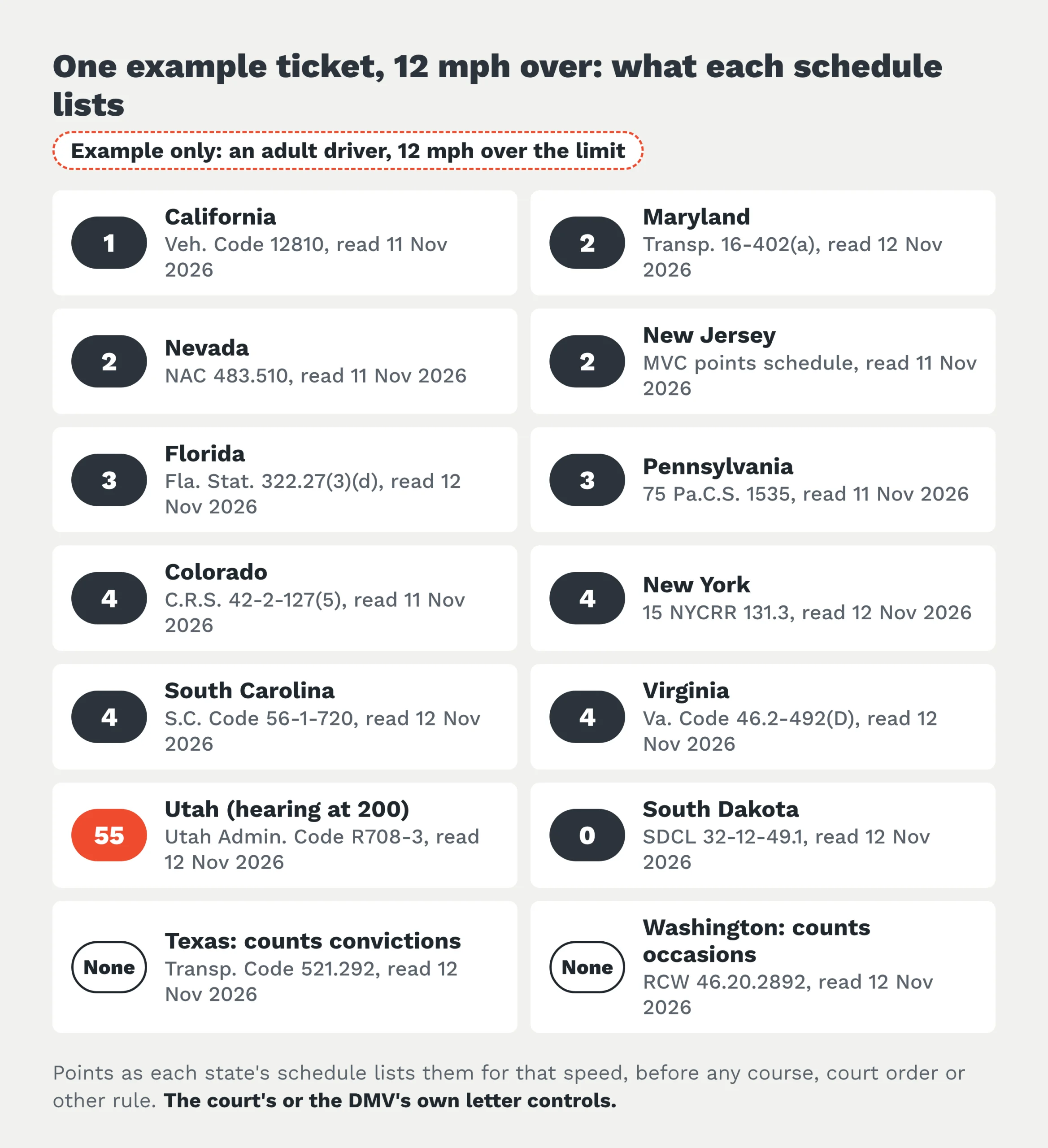
There is no national answer to “how many points is a speeding ticket.” Each state sets its own schedule, and some use no points at all. Most California speeding tickets carry 1 point. Florida gives 3 for up to 15 mph over. New York gives 3 to 11, depending on how far over the limit the driver was. Utah uses a large scale, with 35 to 75 points per speeding ticket and an adult hearing at 200, and South Dakota gives speeding no points. Thirteen states don’t use points at all: they count convictions or occasions instead. This page sets out how points work in each of the 50 states and DC, with the statute or rule behind every number. It is the lead guide in our Points and Records section.
This page is general information about the law, not legal advice and not a substitute for the advice of an attorney. Traffic, license and SR-22 rules vary by state and change. The court’s or the DMV’s own letter controls.
Speeding points in 15 states
These are the speeding entries in each state’s own schedule, as the statute or rule words them. “Over” means miles per hour over the posted or lawful limit. Each state has its own page with the rest of the schedule. For all 51 jurisdictions, see the table further down.
| State | Speeding points in the state’s schedule | Source, date read |
|---|---|---|
| California | 1 for most speeding; 2 for over 100 mph | Veh. Code 12810, 11 Nov 2026 |
| Colorado | 1-4 over: 0; 5-9: 1; 10-19: 4; 20-39: 6; 40+: 12 | C.R.S. 42-2-127(5), 2026 C.R.S., 11 Nov 2026 |
| Florida | Up to 15 over: 3; more than 15 over: 4; speed causing a crash: 6; speeding enforced by a traffic infraction enforcement officer under s. 316.1896 (speed-detection system): no points | Fla. Stat. 322.27(3)(d), 2026 Statutes, 12 Nov 2026 |
| Illinois | Weights used only after 3 convictions in 12 months: 1-10 over: 5; 11-14: 15; 15-25: 20; 26+: 50 | 92 Ill. Adm. Code 1040.20, 11 Nov 2026 |
| Maryland | Under 10 over: 1 (as an unlisted moving violation); 10+ over: 2; 20+ over a 65 mph limit: 5; 30+ over: 6 | Transp. 16-402(a), 12 Nov 2026 |
| Nevada | 1-10 over: 1; 11-20: 2; 21-30: 3; 31-40: 4; 41+: 5 | NAC 483.510, 11 Nov 2026 |
| New Jersey | 1-14 over: 2; 15-29: 4; 30+: 5 | MVC points schedule (agency page), 11 Nov 2026 |
| New York | 1-10 over: 3; 11-20: 4; 21-30: 6; 31-40: 8; more than 40: 11; work-zone speeding: 8 | 15 NYCRR 131.3, violations from 16 Feb 2026, 12 Nov 2026 |
| North Carolina | Speeding over 55 mph: 3; 55 mph or under: 2. School-zone speeding is listed separately in the schedule | G.S. 20-16(c), 11 Nov 2026 |
| Ohio | 30+ over: 4; more than 10 over on a 55+ mph road or more than 5 over on a slower road: 2; less: 0 | R.C. 4510.036, 11 Nov 2026 |
| Pennsylvania | 6-10 over: 2; 11-15: 3; 16-25: 4; 26-30: 5; 31+: 5 plus a hearing | 75 Pa.C.S. 1535, 11 Nov 2026 |
| South Carolina | Up to 10 over: 2; 11-24: 4; 25+: 6 | S.C. Code 56-1-720, 11 Nov 2026 |
| Texas | No points: convictions are counted | Transp. Code 521.292, 12 Nov 2026 |
| Virginia | 1-9 over: 3; 10-19: 4; 20+: 6 | Va. Code 46.2-492(D), 12 Nov 2026 |
| Washington | No points: occasions are counted | RCW 46.20.2892, 12 Nov 2026 |
To add up your own tickets against your state’s numbers, the points and suspension checker uses the same rows. It shows the state’s schedule, window and thresholds next to the entries you give it. It never says what a DMV will do.
What a point is
A point (some states say demerit) is a number the state licensing agency adds to your driving record after a conviction for a moving violation. It isn’t added when the ticket is written. A conviction can be a guilty plea, a finding of guilt, or simply paying the fine, which is usually treated as a conviction; each state page says how its law handles it. Our page on paying or contesting a ticket explains what each choice means in law.
Points matter because the state’s statute or rule names a threshold (a number of points) inside a window (a period of months or years). Reaching it starts something the law describes: a warning letter, a required course, a hearing, a suspension or a revocation. Three details change the arithmetic in many states:
- One stop, one charge counted. Several convictions from the same stop usually add points for the most serious one only. Maryland says so in Transp. 16-402(b) and Virginia in 46.2-492(E) (both read 12 Nov 2026). Washington counts all the infractions from one traffic stop as one “occasion” (RCW 46.20.2892).
- The date that counts. Some windows run from the offense date and some from the conviction date. Maryland assesses points “as of the date of violation” (16-402(a)). Nevada’s points drop 12 months after the conviction date (NAC 483.500(2)). Ohio measures 2 years from the first conviction (R.C. 4510.037).
- Insurance points are different. Some states also run a separate point plan for car insurance. Examples are North Carolina’s Safe Driver Incentive Plan (Rate Bureau Rule 5, effective 1 Jul 2025) and Massachusetts’s Safe Driver Insurance Plan (211 CMR 134.13). These points set premiums, not license suspensions, and their numbers differ from the license points. See what a ticket can mean for insurance.
There is no national point system
No federal law gives an ordinary driver points. Every point value, threshold and window on this page is state law. Two shared systems link the states for ordinary drivers: an agreement among the states, and a federal register:
- The Driver License Compact. This is an agreement that each member state adopted in its own law, not a federal law. States trade conviction reports under it. AAMVA, the compact’s secretariat, lists 48 member jurisdictions in its April 2026 chart; Georgia, Michigan and Wisconsin are not members. The home state must treat only four kinds of out-of-state conviction as if they happened at home: vehicle manslaughter or negligent homicide, driving under the influence, a felony using a vehicle, and failing to stop and render aid after a crash that kills or injures someone (Art. IV(a)). For everything else, including speeding, the home state gives the conviction “such effect … as is provided by the laws of the home state” (Art. IV, as Virginia adopted it in Va. Code 46.2-483, read 12 Nov 2026).
- The National Driver Register. States report revoked and suspended drivers and serious convictions to the federal register within 31 days after the state receives the information. Licensing agencies check the register before they issue or renew a license (49 U.S.C. 30304, US Code 2024 edition, read 12 Nov 2026).
Commercial driver’s license (CDL) and commercial learner’s permit (CLP) holders face a federal layer on top of their state’s points, set out in the section on age and license type below.
Where points turn into a suspension
Each state draws its own line. The table below gives the line in the states with launch pages, with the length as the text words it. Where a statute says “not more than”, the real length can be shorter. Where it says “may”, the agency decides. Where the rule gives no length, we don’t add one. The reasons licenses get suspended go well beyond points, and they are explained on that page.
| State | The line | What the text says happens | Source, read |
|---|---|---|---|
| California | 4 points in 12 months, 6 in 24 or 8 in 36 | The driver is “presumed to be a negligent operator” | Veh. 12810.5(a), 11 Nov 2026 |
| Colorado (adults) | 12 in 12 months or 18 in 24 | Suspension, length set at a hearing; the statute caps it at 1 year. The DOR hearings page describes a 6-month starting point | C.R.S. 42-2-127(1), 42-2-132(1), 11-12 Nov 2026 |
| Florida | 12 in 12 months; 18 in 18; 24 in 36 | Suspension “for not more than 30 days”; “not more than 3 months”; “not more than 1 year” | Fla. Stat. 322.27(3)(a)-(c), 12 Nov 2026 |
| Illinois | 3 or more moving convictions for offenses within 12 months | Only then are the weights added up; the action depends on the total, from none to revocation | 625 ILCS 5/6-206(a)(2); 92 Ill. Adm. Code 1040.30, 11-12 Nov 2026 |
| Maryland | 8 points within any 2 years; 12 points within any 2 years | Suspension at 8; revocation at 12. A first suspension “may not be for less than 2 days nor more than 30 days”; a later one 15 to 90 days | Transp. 16-404(a), (c), 12 Nov 2026 |
| Nevada | 12 in 12 months | Suspension for 6 months; 1 year for a second within 3 years | NRS 483.475, 11 Nov 2026 |
| New Jersey | 12 or more points | The MVC sends a notice of scheduled suspension; lengths not confirmed in official rule text | MVC suspension page, 12 Nov 2026 |
| New York | 11 in 24 months; 9 speeding points in 24 months; 4 more within 12 months after a hearing | DMV may hold a hearing “at which suspension or revocation action may be taken”; the rule sets no length | 15 NYCRR 131.4(c), 12 Nov 2026 |
| North Carolina | 12 in 3 years (8 in 3 years after a reinstatement) | First suspension “not more than 60 days”; second not more than 6 months; later not more than 1 year | G.S. 20-16(a)(5), (c), 11 Nov 2026 |
| Ohio | 12 or more within 2 years | Class D suspension, 6 months | R.C. 4510.037(B), 4510.02, 11 Nov 2026 |
| Pennsylvania | 6 points (first time); 11 or more | At 6, an exam or driver school; at 11, 5 days per point the first time, 10 the second, 15 the third, then 1 year | 75 Pa.C.S. 1538, 1539, 11 Nov 2026 |
| South Carolina | 12 points | The DMV “may suspend” for not more than 6 months; the bands run from 3 months at 12-15 points to 6 months at 20 or more | S.C. Code 56-1-740(A), 12 Nov 2026 |
| Virginia | 18 in any 12 consecutive months or 24 in any 24 | A 90-day suspension, then until a clinic is finished, or 9 months in the Intelligent Speed Assistance Program plus a clinic. The DMV’s written notice gives the choice; a driver who does not answer within 30 days of receiving it is suspended | Va. Code 46.2-506(B), 12 Nov 2026 |
Virginia’s speed-assistance option was added to 46.2-506 by Acts 2025, c. 652. We could not confirm on a DMV page when enrollment opened. The DMV’s letter says which options a driver has. Lower lines come first in several states: Virginia’s DMV requires a driver improvement clinic at 12 points in 12 months or 18 in 24 for drivers 18 and over (46.2-498), and New York sends a letter at 4 to 6 points (131.4(a)).
Reaching a line in the statute is not the same as a suspension order. The agency acts by notice. Many states offer a hearing first, and some, like Colorado and New York, decide the outcome at the hearing. The notice from the DMV, not the arithmetic, says what happens and when.

The 13 states with no points
These states keep no point total on an ordinary driver’s license. Most count convictions or occasions in a window instead. A speeding ticket in these states adds no points. The conviction still goes on the record and can still count toward the state’s line.
| State | What is counted instead | Source, read |
|---|---|---|
| Texas | 4 or more moving-violation convictions from different incidents in 12 consecutive months, or 7 or more in 24, from any state or Canadian province; under 18: 2 in 12 months | Transp. Code 521.292, 12 Nov 2026 |
| Washington | Moving-violation infractions on 3 or more occasions in 1 year or 4 or more in 2 years: a 60-day suspension and 1 year of probation; one traffic stop is one occasion. Since 1 Apr 2026, finishing the required safe driving course after the notice ends the suspension early, once every 5 years, with probation still following | RCW 46.20.2892, 12 Nov 2026 |
| Oregon | “Driver improvement” offenses: for adults, 3 in 24 months brings a restriction and 5 in 24 a 30-day suspension | OAR 735-072-0027, 11 Nov 2026 |
| Minnesota | Convictions: after a warning letter, 4 in 12 months or 5 in 24 months brings 30 days, rising to 1 year at 8 or more in 24 months | Minn. R. 7409.2200, 12 Nov 2026 |
| Louisiana | Habitual offender: 10 or more moving-violation convictions committed within 3 years of the last one (offenses within 12 hours count as one); no license until 3 years after the order and proof of financial responsibility | La. R.S. 32:1472, 32:1479, 12 Nov 2026 |
| Iowa | Habitual violator: 3 or more moving violations committed within 12 months, a count set in the DOT rule (IAC 761-615.6), read only in an unofficial copy; the first two speeding tickets in 12 months of 10 mph or less over in 35-55 mph zones are not counted (statute) | Iowa Code 321.210(2), 11 Nov 2026; IAC 761-615.6 (unofficial copy): partly |
| Kansas | 3 or more moving violations committed on separate occasions within 12 months: the division “is authorized to restrict, suspend or revoke”; length not confirmed | K.S.A. 8-255(a)(2), 12 Nov 2026 |
| Mississippi | No point system found in what we read. The conviction count that leads to a suspension is not confirmed in the statute | Miss. Code not read in official text: not confirmed |
| Hawaii | No point count found. What the courts may do on a moving-violation conviction is not confirmed in official text | HRS 286-125 not read in official text: not confirmed |
| Montana | No ordinary point suspension. Conviction points count only toward habitual traffic offender status: 30 in 3 years (speeding is 3, except low-speed tickets the law keeps off the record, 61-8-725(2)), then a 3-year revocation | MCA 61-11-203, 61-11-211, 2025 MCA, 11 Nov 2026 |
| Rhode Island | 4 listed moving violations on separate occasions within 18 months: the court may suspend up to 1 year or revoke up to 2 | R.I. Gen. Laws 31-27-24, 11 Nov 2026 |
| Wyoming | “Repeated violator”: the division “may suspend” for a period not to exceed 12 months; the count is in a WYDOT rule we have not read | W.S. 31-7-129(a)(i), 12 Nov 2026: threshold not confirmed |
| Massachusetts | Surchargeable events, not license points. The count that brings a required course or a suspension is not confirmed in official text. Insurance plan points are separate (211 CMR 134.13) | M.G.L. c. 175 s. 113B not read in full: not confirmed |
Two notes on the edges of this list. Montana’s statute does assign “points”, but only to decide habitual-offender status, not as a running license total, so we count it here. Wyoming’s threshold sits in a WYDOT rule we could not read in official text, so the table gives no number for it.
Scales that work differently
- Illinois weighs offenses but doesn’t keep a running total like other states. The Secretary of State acts on a driver who has 3 or more moving convictions for offenses within 12 months (625 ILCS 5/6-206(a)(2); all three versions of the section in force in 2026 read the same here). Only then are the weights in 92 Ill. Adm. Code 1040.20 added up. With no earlier suspension, 0-14 points brings no action, 15-44 a 2-month suspension, and 110 or more a revocation (1040.30(a)). Drivers under 21 face a lower line: 2 or more convictions in 24 months (1040.29). A court may not grant supervision for a moving violation to a driver who already received supervision twice in the 12 months before the arrest (730 ILCS 5/5-6-1(k), read 11 Nov 2026).
- Utah uses large numbers. The statute tells the Driver License Division to set a point system. It grades speeding as “minimum” (up to 10 over), “intermediate” (11 to 20) and “maximum” (21 or more), and it caps how long points stay at 3 years (Utah Code 53-3-221(4), current version on the Legislature’s site, read 12 Nov 2026). The division’s rule sets 35, 55 and 75 points for those bands. An adult at 200 points must appear for a hearing, and 200 to 299 points can bring probation or a 3-month suspension, rising to 1 year at 600 or more; drivers under 21 face a hearing at 70. Points drop off 3 years after the violation, halve after 1 violation-free year and clear after 2, and a defensive driving course takes 50 off once in 3 years (Utah Admin. Code R708-3-4 to -8, effective 21 Aug 2025, read 12 Nov 2026).
- South Dakota lists points for, among others, drunk driving (10), reckless driving (8), failure to yield (4), stop sign or light (3) and “other moving offenses” (2). Then it adds: “‘other moving offenses’ does not include speeding offenses” (SDCL 32-12-49.1, read 12 Nov 2026). Its line is 15 points in 12 consecutive months or 22 in 24 (32-12-49.2).
- Michigan assigns 1 to 4 points for speeding, depending on the mph. At 12 or more in 2 years, the law calls for a driver reexamination, not an automatic suspension; the Secretary of State may then suspend for up to 1 year (MCL 257.320a, 257.320, read 11 Nov 2026).
- Indiana assigns points by BMV schedule, but we have not read the statute or rule that sets them (IC 9-30 and 140 IAC not read), so this page gives no Indiana point values or line: not confirmed.
- Kentucky gives 0 points for speeding 10 mph or less over on a limited-access highway with a 65 mph or higher limit (KRS 186.572), 3 for other speeding up to 15 over, and 6 for 16 to 25 over. Speeding 26 or more over carries no points but is listed as a serious violation that may bring a 90-day suspension or probation after an informal hearing (601 KAR 13:025 ss. 3-4, both read 12 Nov 2026). The line is 12 points in 2 years for drivers 18 and over, 7 under 18, and the cabinet “may” suspend there (s. 6).
How long points last: three different clocks
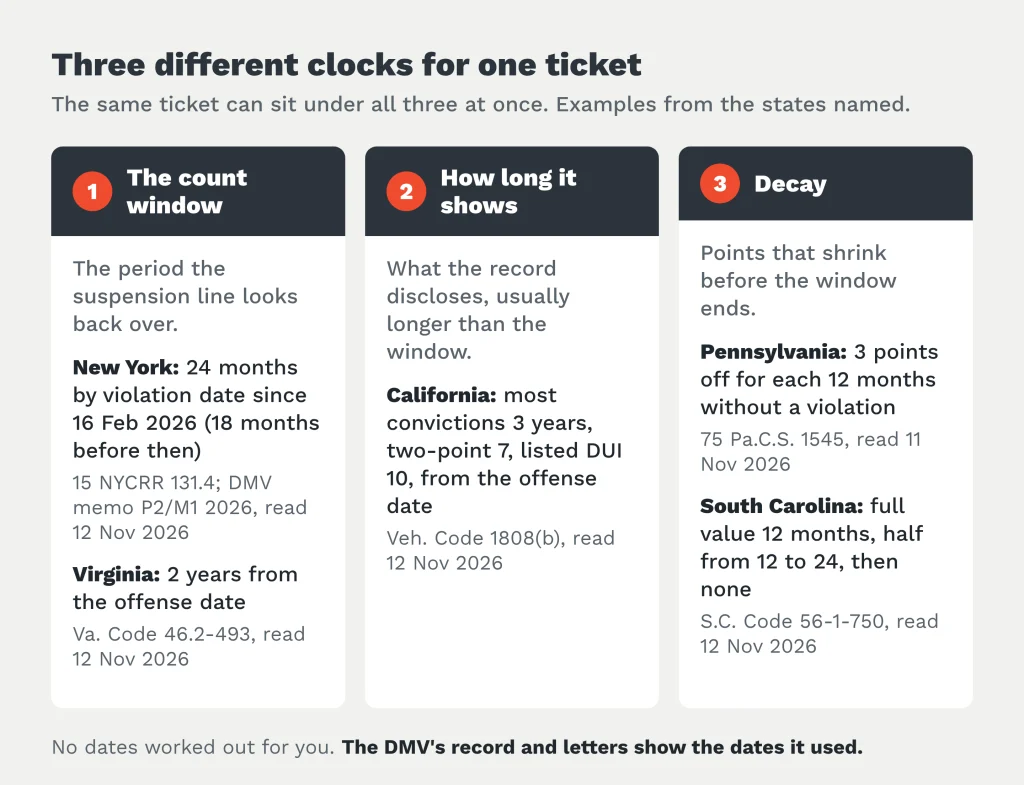
Many sites ask “how long do points last?” as if there were one answer. The law has three separate clocks, and a single ticket can be under all three at once:
- The count window is the period the suspension line looks back over. Since 16 Feb 2026, New York’s look-back for points action is 24 months, counted by violation date; before that date it was 18 months (15 NYCRR 131.4; DMV memo P2/M1 2026, read 12 Nov 2026). The new point values apply to violations committed on or after 16 Feb 2026 (131.3(c)). Virginia’s demerit points count for 2 years from the offense date (Va. Code 46.2-493, read 12 Nov 2026). California uses three windows at once: 12, 24 and 36 months (12810.5(a)).
- How long it shows on the record. This is the record that employers and insurers may see, and it usually lasts longer than the window. California’s DMV discloses most convictions for 3 years from the date of the offense, two-point convictions for 7, and listed DUI convictions for 10 (Veh. Code 1808(b), read 12 Nov 2026). The New Jersey MVC keeps a permanent record (MVC page).
- Decay means points that shrink before the window ends. Pennsylvania removes 3 points for each 12 months without a violation (75 Pa.C.S. 1545, read 11 Nov 2026). South Carolina counts points from violations in the 12 months up to the latest violation at full value, from 12 to 24 months before it at half, and older ones not at all (S.C. Code 56-1-750, read 12 Nov 2026). New Jersey’s MVC takes off 3 points for each 12 months without a violation or suspension (MVC page). Virginia awards one “safe driving point” for each calendar year with no conviction or suspension, up to 5, and uses them to offset demerit points (Va. Code 46.2-494, read 12 Nov 2026).
Each clock is explained state by state, with what the record shows and for how long, on how long points stay on your record.
Age, provisional licenses and CDLs
The adult line doesn’t apply to everyone. Young drivers and commercial license holders reach a line much sooner:
- California provisional license: 2 points in 12 months brings a 30-day restriction; 3 points in 12 months brings a 6-month suspension and 1 year of probation (Veh. 12814.6(g), 11 Nov 2026).
- New York: a probationary license is suspended for 60 days on a first speeding conviction or a second other conviction (VTL 510-b). A junior license is suspended for 60 days after one serious traffic violation, which includes speeding 10 or more over (VTL 510-c, both read 12 Nov 2026).
- Florida, ages 15 to 17: 6 points in 12 months restricts the license to business purposes for at least 1 year, longer with more points, and the restriction ends at 18 if no other grounds exist (Fla. Stat. 322.161, 12 Nov 2026).
- Maryland, provisional license under 18: 5 or more points in 12 months brings a suspension for 6 months for a first offense and 1 year for a second or later one (Transp. 16-404(d), 12 Nov 2026).
- Texas, under 18: 2 moving-violation convictions within 12 months (Transp. 521.292(a)(8), 12 Nov 2026).
- Colorado: 9 points in 12 months, 12 in 24, or 14 after turning 18 for drivers aged 18 to 20. For drivers under 18, more than 5 in 12 months or more than 6 for violations before turning 18. Chauffeurs have their own higher lines (C.R.S. 42-2-127, 11 Nov 2026).
- Virginia, under 18: any demerit conviction brings a required clinic, a second a 90-day suspension, and a third a revocation for 1 year or until age 18, whichever is longer (Va. Code 46.2-334.01, 12 Nov 2026).
CDL and CLP holders keep their state’s points and add a federal count on top. Under 49 CFR 383.51, speeding 15 mph or more over the limit is a “serious traffic violation”. A second serious violation in a separate incident within 3 years brings a 60-day disqualification from driving a commercial vehicle. A third brings 120 days. In a personal car, these convictions count only if the conviction leads to a suspension, revocation or cancellation of the license. One serious violation on its own carries no federal disqualification. The state may not mask, defer or divert a CDL or CLP holder’s conviction in any vehicle, other than for parking, weight or defect violations (49 CFR 384.226). Since 22 Jul 2026, drivers no longer have to report out-of-state convictions to their licensing state (91 FR 37047), but the written notice to the employer within 30 days still stands (49 CFR 383.31). The eCFR for title 49 was up to date as of 9 Nov 2026 when we read these sections on 12 Nov 2026. More on what a ticket means for a CDL.
Tickets from another state
Between compact members, what an out-of-state speeding conviction does to your license is decided by your home state’s law, not the law of the state where you were stopped (Driver License Compact, Art. IV(b)). Home states differ a great deal:
- Virginia’s DMV assigns points to convictions from any other state, as if the offense had happened in Virginia (Va. Code 46.2-492(B), read 12 Nov 2026).
- Texas counts moving-violation convictions “of the traffic laws of any state, Canadian province, or political subdivision” toward its 4-in-12 and 7-in-24 lines (Transp. 521.292(b), read 12 Nov 2026).
- Utah’s division may not assess points for out-of-state violations committed on or after 1 Jul 2011. The exceptions are reckless or impaired driving, speeding 21 or more over, and offenses that would bring a mandatory suspension in Utah (Utah Code 53-3-221(4)(b), read 12 Nov 2026).
- New Jersey’s MVC assigns 2 points for a moving violation in another state (MVC points schedule, 11 Nov 2026).
- Kentucky assesses points for out-of-state convictions, except that “a speeding violation in another state shall not be assessed penalty points” (601 KAR 13:025, read 12 Nov 2026).
Georgia, Michigan and Wisconsin are outside the Driver License Compact (AAMVA chart, April 2026), and their own laws decide what they do with out-of-state convictions. The details are on out-of-state traffic tickets.
What a course can do to points
A traffic school or defensive-driving course does something different in each state, and some states have no course at all for points. The four types, with examples:
- The ticket doesn’t count. In Texas, the court dismisses the charge after a driving safety course: not if the driver completed a course in the 12 months before the offense, not for 25 or more over or 95 mph or more, never for a CDL holder (Code Crim. Proc. 45A.351-.352, read 12 Nov 2026). In Florida, electing a basic driver improvement course means no points: not if elected in the prior 12 months, at most 8 times in a lifetime, not for CDL holders or 30 or more over (Fla. Stat. 318.14(9), read 12 Nov 2026).
- The conviction is kept confidential. California keeps one 1-point conviction per 18 months confidential (Veh. 1808.7, 42005, read 12 Nov 2026).
- A credit against the total. Ohio gives a 2-point credit to a driver with 2 to 11 points, once every 3 years, 5 times in a lifetime (R.C. 4510.037, read 11 Nov 2026). Virginia’s clinic subtracts 5 demerit points (or awards safe driving points when fewer are on the record), and that benefit can be had once within 2 years (Va. Code 46.2-498(C), read 12 Nov 2026). North Carolina takes 3 points off once every 5 years (G.S. 20-16(c), read 11 Nov 2026), and South Carolina 4 points, not more than once in any 3-year period (56-1-770, read 12 Nov 2026). Nevada takes up to 3 off, but only after a DMV notice at 3 to 11 points, once per 12 months, and not after reaching 12 (NRS 483.475, read 11 Nov 2026).
- Off the count only. New York’s PIRP course takes up to 4 points off the total used for suspension, not off the record, once per 18 months (15 NYCRR 131.5, read 12 Nov 2026).
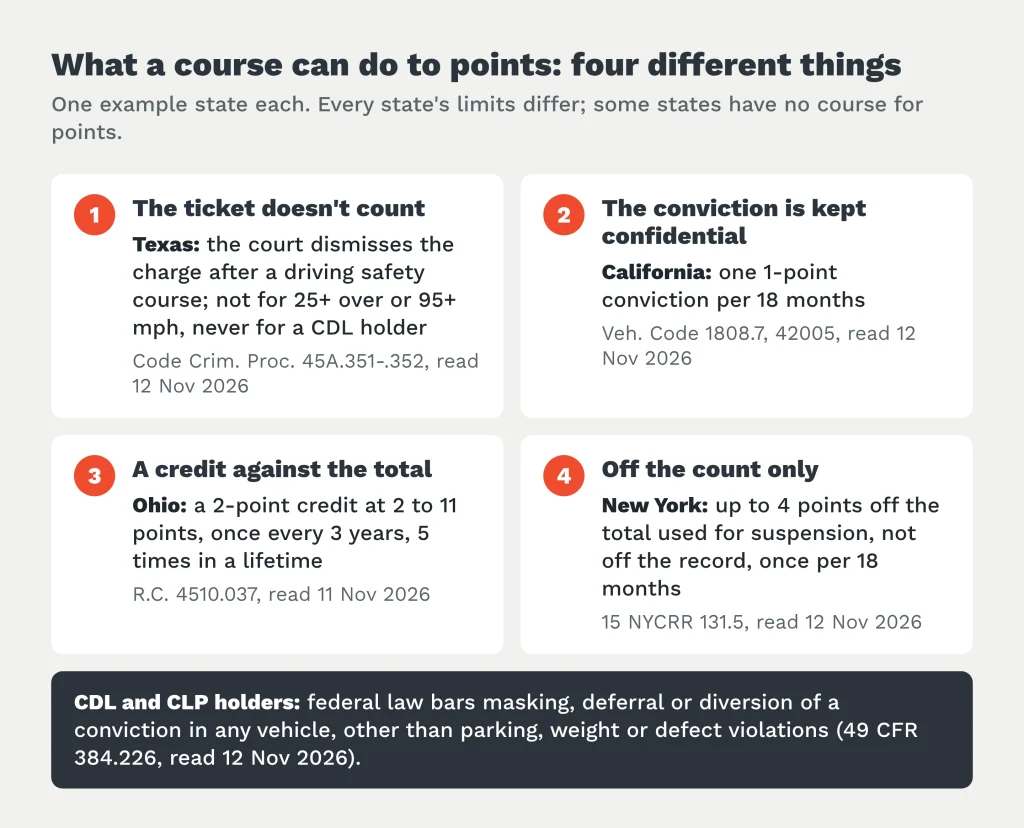
Federal law bars masking for CDL and CLP holders (49 CFR 384.226). California’s Vehicle Code lets a court keep a commercial holder’s car ticket out of the negligent-operator count, but the conviction is not kept confidential (Veh. 42005(b)). Course rules, limits and who can’t take a course, state by state: traffic school by state. Other ways points come off the count: how points come off a license.
Claims you may see elsewhere
You may see the claims below on other sites. We checked each one against the statute, and none of them is what the text says.
- “A speeding ticket is 3 or 4 points.” That is roughly Florida’s schedule. It is 1 point in most California cases, 0 in South Dakota, 35 to 75 on Utah’s scale, and no points at all in 13 states.
- “Texas points.” Texas has had no point surcharges since H.B. 2048 repealed chapter 708 of the Transportation Code, its Driver Responsibility Program, effective 1 Sep 2019 (H.B. 2048, 86th Leg., enrolled text, sections 15 and 17, read 12 Nov 2026). Suspension rests on conviction counts (Transp. 521.292).
- “New York suspends at 11 points in 18 months.” Since 16 Feb 2026, the look-back is 24 months (DMV memo P2/M1 2026). Reaching 11 points can lead to a hearing where DMV may suspend or revoke; the rule sets no automatic suspension and no length (15 NYCRR 131.4(c)).
- “Washington suspends after 6 tickets in a year.” The statute says 3 occasions in 1 year or 4 in 2 years (RCW 46.20.2892(1)).
- “Points follow you to every state.” Under the compact, the home state scores an out-of-state conviction under its own law. Some states add points for it, some count the conviction, and Utah generally adds none.
All 50 states and DC at a glance
Short cells only. Each state has its full row on points and suspension rules by state. That page has the statute link, the five lines that decide what a ticket does, and the read date. “Read” means we read the core numbers in the official statute or rule. “Partly” means some of the row was read in official text and the rest says “not confirmed”, as named. Anything not read in official text says “not confirmed” and links the state’s own page.
| State | System | Speeding points | The line | Source, read | Status |
|---|---|---|---|---|---|
| Alabama | Points (ALEA rule) | 1-25 over: 2; 26+: 5 | 12-14 points in 2 years: 60 days, rising by band | Ala. Admin. Code r. 760-X-1-.07, 11 Nov 2026 | Read |
| Alaska | Points | 3-9 over: 2; 10-19: 4; 20+: 6 | 12 in 12 months or 18 in 24 | AS 28.15.221-.261; 2 AAC 90, 11 Nov 2026 | Read |
| Arizona | Points (ADOT rule) | Not confirmed | Not confirmed: the statute lets ADOT suspend or require traffic survival school for frequent violations; the point rule (R17-4-404) not read in official text | A.R.S. 28-3306, 12 Nov 2026 | Not confirmed |
| Arkansas | Points (DFA rule) | 1-10 over: 3; 11-20: 4; 21-30: 5; 31+: 8 | 14 or more (convictions in the 36 months before the hearing): the office “may suspend” for no more than 3, 6 or 12 months by band | DFA Driver Services Reg. 1993-9 (agency PDF), 12 Nov 2026 | Partly (rule read; statute not) |
| California | Points (negligent operator) | Most speeding: 1; over 100 mph: 2 | 4 in 12 months, 6 in 24, 8 in 36 | Veh. 12810, 12810.5, 11 Nov 2026 | Read |
| Colorado | Points | 1-4 over: 0; 5-9: 1; 10-19: 4; 20-39: 6; 40+: 12 | Adults 12 in 12 months or 18 in 24 | C.R.S. 42-2-127, 11 Nov 2026 | Read |
| Connecticut | Points (regulation) | Speeding: 1 | More than 10 in 24 months: 30 days | C.G.S. 14-137a; Regs. 14-137a-5 to -9, 11 Nov 2026 | Read |
| Delaware | Points (regulation) | 1-9 over: 2; 10-14: 4; 15-19: 5; 20+: 5 plus action | 12 or more in 24 months: course or 2 months | 2 DE Admin. Code 2208, 11 Nov 2026 | Read |
| District of Columbia | Points (18 DCMR 303) | Not confirmed | Not confirmed (DMV chart only; 18 DCMR 303 not read) | DC DMV point chart, 11 Nov 2026 | Not confirmed |
| Florida | Points | Up to 15 over: 3; more than 15: 4 (none for speed-detection-system tickets under s. 316.1896) | 12 in 12 months; 18 in 18; 24 in 36 | Fla. Stat. 322.27(3), 12 Nov 2026 | Read |
| Georgia | Points | Not confirmed | Not confirmed (O.C.G.A. 40-5-57 not read) | Georgia DDS points page, 11 Nov 2026 | Not confirmed |
| Hawaii | No points found | None found | Not confirmed | HRS 286-125 not read in official text | Not confirmed |
| Idaho | Points | 1 to 4 per violation (statute); values by mph not confirmed (rule read only in an archive copy) | 12 in any 12 consecutive months (statute); 18 in 24 and 24 in 36 in the IDAPA 39.02.71 rule (archive copy, not official text) | Idaho Code 49-326, 12 Nov 2026; IDAPA 39.02.71 (archive copy), 11 Nov 2026 | Partly |
| Illinois | Weighted conviction count | 1-10 over: 5; 11-14: 15; 15-25: 20; 26+: 50 | Only after 3 moving convictions in 12 months | 625 ILCS 5/6-206; 92 Ill. Adm. Code 1040, 11-12 Nov 2026 | Read |
| Indiana | Points (BMV schedule) | Not confirmed | Not confirmed (IC 9-30 and 140 IAC not read) | Indiana BMV points page, 11 Nov 2026 | Not confirmed |
| Iowa | No points: convictions | None | 3 or more moving violations in 12 months, as set in the DOT rule (IAC 761-615.6, unofficial copy, not official text) | Iowa Code 321.210; IAC 761-615.6 (unofficial copy), 11 Nov 2026 | Partly |
| Kansas | No points: convictions | None | 3 moving violations on separate occasions in 12 months | K.S.A. 8-255(a)(2), 12 Nov 2026 | Read |
| Kentucky | Points | Up to 15 over: 3 (0 for 10 or less over on a 65+ limited-access highway); 16-25: 6; 26+: no points, but listed as a serious violation that may bring a 90-day suspension or probation after a hearing | 12 in 2 years (under 18: 7) | 601 KAR 13:025; KRS 186.572, 12 Nov 2026 | Read |
| Louisiana | No points: convictions | None | 10 or more moving convictions in 3 years | La. R.S. 32:1472, 12 Nov 2026 | Read |
| Maine | Points (SOS rule) | Not confirmed | Not confirmed: 29-A M.R.S. 2458(3) leaves the schedule and the line to a Secretary of State rule we read only in an unofficial copy | 29-A M.R.S. 2458(3), 12 Nov 2026 | Not confirmed |
| Maryland | Points | Under 10 over: 1; 10+: 2; 20+ over a 65 limit: 5; 30+: 6 | 8 in 2 years: suspension; 12: revocation | Transp. 16-402, 16-404, 12 Nov 2026 | Read |
| Massachusetts | No points: surchargeable events | None (insurance plan points are separate) | Not confirmed in official text | M.G.L. c. 175 s. 113B not read in full | Not confirmed |
| Michigan | Points | 1 to 4 by mph | 12 or more in 2 years: reexamination | MCL 257.320a, 257.320, 11 Nov 2026 | Read |
| Minnesota | No points: convictions | None | 4 in 12 months or 5 in 24, after a warning letter | Minn. R. 7409.2200, 12 Nov 2026 | Read |
| Mississippi | No points found | None found | Not confirmed | Miss. Code not read in official text | Not confirmed |
| Missouri | Points | State speeding: 3; municipal: 2 | 8 in 18 months | RSMo 302.302, 302.304, 11-12 Nov 2026 | Read |
| Montana | No ordinary points (habitual-offender points) | Speeding: 3 (habitual-offender count only) | 30 in 3 years: habitual offender, 3-year revocation | MCA 61-11-203, 61-11-211 (2025 MCA), 11 Nov 2026 | Read |
| Nebraska | Points | Most roads: 6-10 over: 2; 11-35: 3; over 35: 4 (no value listed for 5 or less over). 65-75 mph state-system roads, interstates included: 1-10 over: 1; 11-15: 2; 16-35: 3 | 12 in 2 years: 6-month revocation | Neb. Rev. Stat. 60-4,182 to -4,188, 11 Nov 2026 | Read |
| Nevada | Demerit points | 1-10 over: 1; 11-20: 2; 21-30: 3; 31-40: 4; 41+: 5 | 12 in 12 months: 6 months | NAC 483.510; NRS 483.475, 11 Nov 2026 | Read |
| New Hampshire | Points (rule) | Not confirmed | Not confirmed (Saf-C 212 not reachable in official text) | NH DMV demerit points page, 11 Nov 2026 | Not confirmed |
| New Jersey | Points | 1-14 over: 2; 15-29: 4; 30+: 5 | 12 or more: notice of scheduled suspension | MVC points and suspension pages, 11-12 Nov 2026 | Read (agency) |
| New Mexico | Points (rule) | 6-15 over: 3; 16-25: 5; 26+: 8, on the limits the rule lists | 12 or more in 12 months: 12 months | 18.19.5 NMAC, 11 Nov 2026 | Read |
| New York | Points | 1-10 over: 3; 11-20: 4; 21-30: 6; 31-40: 8; 40+: 11 | 11 in 24 months, or 9 speeding points: hearing | 15 NYCRR 131.3-131.4, 12 Nov 2026 | Read |
| North Carolina | Points | Over 55 mph: 3; most other speeding: 2 (school zone listed separately) | 12 in 3 years | G.S. 20-16, 11 Nov 2026 | Read |
| North Dakota | Points | By mph band (e.g. 16-20 over on a 65 mph or lower road: 3) | 12 or more points: suspension | NDCC 39-06.1-10, -13, 11-12 Nov 2026 | Read |
| Ohio | Points | Over 5 or 10 by road: 2; 30+ over: 4 | 12 or more in 2 years: 6 months | R.C. 4510.036, 4510.037, 11 Nov 2026 | Read |
| Oklahoma | Points | 11-25 over: 2; 26-40: 3; 41+: 4 (Service Oklahoma code book) | 10 or more in 5 years (Service Oklahoma page) | 47 O.S. 6-206; Service Oklahoma Violation Code Book (May 2026), 11 Nov 2026 | Read (statute and agency) |
| Oregon | No points: offenses | None | 5 offenses in 24 months: 30 days | ORS 809.480; OAR 735-072, 11 Nov 2026 | Read |
| Pennsylvania | Points | 6-10 over: 2; 11-15: 3; 16-25: 4; 26+: 5 | 6 points: exam or school; 11+: suspension | 75 Pa.C.S. 1535-1545, 11 Nov 2026 | Read |
| Rhode Island | No points: convictions | None | 4 moving violations in 18 months: court may suspend | R.I. Gen. Laws 31-27-24, 11 Nov 2026 | Read |
| South Carolina | Points | Up to 10 over: 2; 11-24: 4; 25+: 6 | 12 points: “may suspend”, 3 to 6 months by band | S.C. Code 56-1-720, -740, 12 Nov 2026 | Read |
| South Dakota | Points | Speeding: 0 | 15 in 12 months or 22 in 24 | SDCL 32-12-49.1, -49.2, 12 Nov 2026 | Read |
| Tennessee | Points (rule) | 1-5 over: 1; 6-15: 3; 16-25: 4; 26-35: 5; 36-45: 6; 46+: 8 | 12 or more in 12 months: notice of proposed suspension | Tenn. Comp. R. & Regs. 1340-01-04, 11 Nov 2026 | Read |
| Texas | No points: convictions | None | 4 convictions in 12 months or 7 in 24 | Transp. Code 521.292, 12 Nov 2026 | Read |
| Utah | Points (rule, 200 scale) | 1-10 over: 35; 11-20: 55; 21+: 75 | 200 points: hearing (under 21: 70); points drop off after 3 years | Utah Code 53-3-221; Utah Admin. Code R708-3, 12 Nov 2026 | Read |
| Vermont | Points | 2 to 8 by mph | 10 in 2 years | 23 V.S.A. 2502, 11 Nov 2026 | Read |
| Virginia | Demerit points | 1-9 over: 3; 10-19: 4; 20+: 6 | 18 in 12 months or 24 in 24 | Va. Code 46.2-492, -506, 12 Nov 2026 | Read |
| Washington | No points: occasions | None | 3 occasions in 1 year or 4 in 2 | RCW 46.20.2892, 12 Nov 2026 | Read |
| West Virginia | Points (rule) | Not confirmed (91 CSR 5 read only in an unofficial copy) | 12 or more points: suspension (DMV page; the 91 CSR 5 rule read only in an unofficial copy) | W. Va. Code 17B-3-6, 12 Nov 2026; WV DMV points page, 11 Nov 2026 | Partly |
| Wisconsin | Points (rule) | Not confirmed | Not confirmed (Wis. Stat. 343.32 and Trans 101 not reachable) | WisDOT point system page, 11 Nov 2026 | Not confirmed |
| Wyoming | No points: convictions | None | “Repeated violator”: up to 12 months; count not confirmed | W.S. 31-7-129, 12 Nov 2026 | Partly |
What to do next
- Read the ticket and any letter. The citation names the court, the charge and the date to respond. A DMV notice names the action, the date it takes effect and how to ask for a hearing. Those dates come from the paper, not from any table.
- Check your own record and points on the state’s official site. Most licensing agencies let you check your status and order your own driving record. We list each state’s official pages on checking license status, points and your driving record. Use the agency’s own site, not a record seller.
- Use the court’s own forms and self-help center for pleas, written trials or hearing requests. The court’s website lists them. Many state bars run their own lawyer referral service if you want one.
- Put the numbers side by side with the points and suspension checker linked near the top of this page. It shows your state’s line and the read date, and it lists what it can’t see, such as a court order or a conviction not yet reported.
Statutes and rules checked on 12 November 2026. Sections read that day include Fla. Stat. 318.14, 322.161 and 322.27 (2026 Florida Statutes), New York DMV memo P2/M1 2026, Va. Code 46.2-483, 46.2-492 to -498, 46.2-506 and 46.2-334.01 (pages dated 11/12/2026), Md. Transp. 16-402 and 16-404, Tex. Transp. Code 521.292, Tex. Code Crim. Proc. 45A.351-.358, RCW 46.20.2892, Minn. R. 7409.2200, K.S.A. 8-255, SDCL 32-12-49.1 and -49.2, Utah Code 53-3-221 and Utah Admin. Code R708-3, C.R.S. 42-2-127 (2026), S.C. Code 56-1-720 to -770, RSMo 302.302 and 302.304, La. R.S. 32:1472 and 32:1479, W.S. 31-7-129, NDCC 39-06.1-10, 601 KAR 13:025, KRS 186.572, DFA Driver Services Reg. 1993-9, 49 CFR 383.51 and 384.226, and 49 U.S.C. 30304. Other rows rest on readings of the official text on 11 and 12 November 2026, with each date shown beside the row. The eCFR for title 49 was up to date as of 9 Nov 2026.
Sources
- California Vehicle Code 12810.5 (negligent operator)
- California Vehicle Code 1808 (record disclosure)
- Florida Statutes 322.27 (2026)
- New York DMV: the driver point system (15 NYCRR 131)
- New York DMV memo P2/M1 2026 (new point values from 16 Feb 2026)
- Texas Transportation Code chapter 521 (521.292)
- Code of Virginia 46.2-492 (Uniform Demerit Point System)
- Code of Virginia 46.2-493, 46.2-494, 46.2-498, 46.2-506
- Code of Virginia 46.2-483 (Driver License Compact)
- Maryland Transportation 16-402 and 16-404
- RCW 46.20.2892 (Washington)
- Ohio Revised Code 4510.036
- North Carolina G.S. 20-16
- Pennsylvania Vehicle Code chapter 15 (75 Pa.C.S. 1535-1545)
- South Carolina Code title 56 chapter 1 (56-1-720 to -770)
- Colorado Revised Statutes title 42 (2026, OLLS)
- Nevada NRS chapter 483
- New Jersey MVC points schedule
- South Dakota Codified Laws 32-12-49.1
- Utah Code 53-3-221
- Minnesota Rules 7409.2200
- Kansas Statutes 8-255
- Montana Code 61-11-203 (2025 MCA)
- eCFR: 49 CFR 383.51
- eCFR: 49 CFR 384.226
- eCFR: 49 CFR 383.31
- Federal Register: Removal of Self-Reporting Requirement (91 FR 37047, 22 Jun 2026)
- US Code: 49 U.S.C. 30304 (2024 edition)
- AAMVA: DLC and NRVC member chart (April 2026)
- Utah Admin. Code R708-3 (Driver License Point System Administration, eff. 21 Aug 2025)
- Kentucky 601 KAR 13:025 (point system)
- KRS 186.572 (limited-access speeding points)
- Arkansas DFA Driver Services Regulation 1993-9
- Louisiana R.S. 32:1472 (habitual offender)
- Louisiana R.S. 32:1479 (prohibition)
- Texas Code of Criminal Procedure chapter 45A (45A.351-.358)
- Arizona Revised Statutes 28-3306
- Wyoming Statutes title 31 (31-7-129)
- Missouri RSMo 302.304
- Service Oklahoma Violation Code Book (May 2026)
- Tennessee Rules 1340-01-04 (Driver Improvement Program)
- Nebraska Revised Statutes 60-4,182 to 60-4,188
- Texas H.B. 2048, 86th Legislature (2019), enrolled text: repeal of chapter 708