Florida uses points. Under Florida Statutes section 322.27(3), the state’s Department of Highway Safety and Motor Vehicles (FLHSMV, Florida’s DMV) may suspend a license at 12 points within 12 months (for “not more than 30 days”), 18 points within 18 months (“not more than 3 months”) or 24 points within 36 months (“not more than 1 year”), counting each ticket by its offense date. A speeding ticket is 3 points up to 15 mph over and 4 points above that. Many drivers can elect a Basic Driver Improvement (BDI) course instead, so no points are added. That election is limited to once in 12 months and eight in a lifetime, and some drivers and tickets can’t use it. After a DUI, Florida requires higher insurance limits, which FLHSMV calls an FR-44. This page is part of our traffic rules by state series.
This page is general information about the law, not legal advice and not a substitute for the advice of an attorney. Traffic, license and SR-22 rules vary by state and change. The court’s or the DMV’s own letter controls.
Every rule below comes from the 2026 Florida Statutes on the Legislature’s official site (Online Sunshine). We read each section in full on 12 November 2026. You may see the suspension lengths given elsewhere as fixed periods. We checked that against the statute, and it isn’t what the text says: the statute says “not more than”, and it adds limits on the course that are easy to miss. We quote the statute.
The five lines that decide what a Florida ticket does
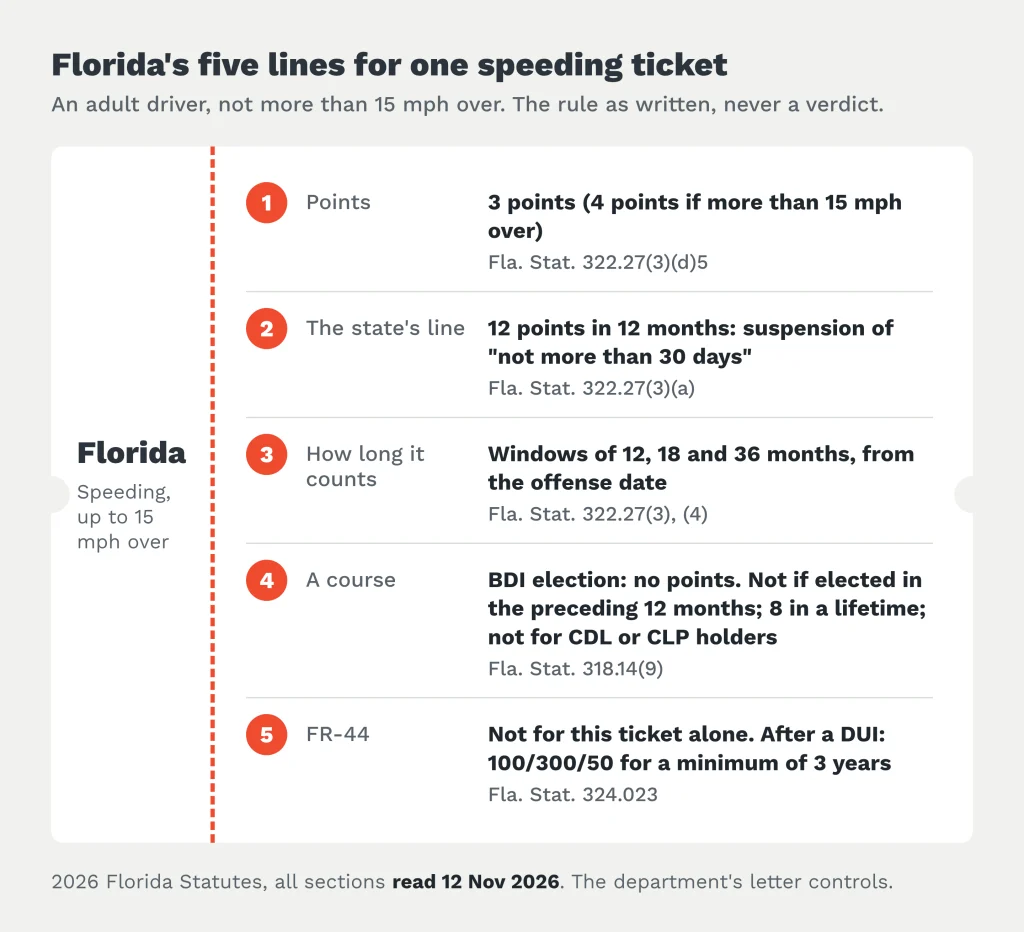
- Points: speeding up to 15 mph over is 3 points and more than 15 mph over is 4. Most other moving violations are 3 points, and the most serious ones are 4 or 6 (Fla. Stat. 322.27(3)(d), read 12 Nov 2026).
- The line: 12 points in 12 months, suspension of “not more than 30 days”. 18 in 18 months, “not more than 3 months”. 24 in 36 months, “not more than 1 year” (322.27(3)(a)-(c), read 12 Nov 2026).
- How long it counts: windows of 12, 18 and 36 months, counted from the offense date (322.27(4)). How long a ticket shows on the record is a separate question (below).
- A course: a BDI election means adjudication is withheld and no points are assessed. It can’t be used if one was elected in the preceding 12 months, and the lifetime limit is 8. It isn’t open to CDL or CLP holders or to tickets for 30 mph or more over (318.14(9), read 12 Nov 2026).
- SR-22 and FR-44: after a DUI, liability limits of 100/300/50 for a minimum of 3 years (324.023, read 12 Nov 2026). Proof kept for 3 years in unpaid-crash-judgment cases and after a DUI suspension or revocation; the section doesn’t say what date starts the 3 years (324.131, read 12 Nov 2026). We found no filing requirement for a points-only suspension in the sections we read.
1. The point schedule
Section 322.27(3)(d) assigns points to convictions. Paying a civil traffic ticket counts: under 318.14(4)(b), a driver who pays (or enters a payment plan) “shall be deemed to have admitted the infraction”, and 318.14(8) then tells the department to enter the points. How license points work in general is covered on its own page. Florida’s schedule:
| Conviction | Points | Fla. Stat. 322.27(3)(d) |
|---|---|---|
| Unlawful speed, not more than 15 mph over the lawful or posted speed | 3 | 5.a |
| Unlawful speed, more than 15 mph over | 4 | 5.b |
| Unlawful speed, or unlawful use of a wireless communications device, resulting in a crash | 6 | 3 |
| Reckless driving, willful and wanton | 4 | 1 |
| Traffic control signal (red light) violation | 4 | 6 |
| Passing a stopped school bus | 4 (6 if it causes serious bodily injury or death) | 4.a, 4.b |
| Leaving the scene of a crash with property damage of more than $50 | 6 | 2 |
| Unlawfully driving through a railroad-highway grade crossing | 6 | 7 |
| Any other moving violation in the schedule (apart from speed and phone use) resulting in a crash | 4 | 9 |
| Using a traffic signal preemption device (316.0775(2)) | 4 | 11 |
| All other moving violations, including parking on a highway outside city limits | 3 | 8 |
| A litter-law conviction under 403.413(6)(b) | 3 | 10 |
| A moving violation with unlawful phone use in a school safety zone | +2 on top of the violation’s points | 12 |
| Speeding, red-light or school-bus tickets enforced by camera (a “traffic infraction enforcement officer” or school bus detection system) | 0, and the ticket “may not be used for purposes of setting motor vehicle insurance rates” | 4.c, 5.c, 6 |
A ticket exactly 15 mph over is “not in excess of 15 miles per hour”, so it is 3 points. DUI is not on the point schedule. It leads to a mandatory revocation instead (322.26(2)), and that is the only way it appears on this page. Fines are set separately, in 318.18(3).
2. The suspension line, in the statute’s words
“The department is authorized to suspend the license of any person upon showing of its records or other good and sufficient evidence that the licensee has been convicted of violation of motor vehicle laws or ordinances … amounting to 12 or more points as determined by the point system. The suspension shall be for a period of not more than 1 year.”
Fla. Stat. 322.27(3), 2026 Florida Statutes, read 12 November 2026
| Points | Within | Suspension, as the statute words it | Section |
|---|---|---|---|
| 12 | 12 months | “not more than 30 days” | 322.27(3)(a) |
| 18 (counting points already acted on under (a)) | 18 months | “not more than 3 months” | 322.27(3)(b) |
| 24 (counting points already acted on under (a) and (b)) | 36 months | “not more than 1 year” | 322.27(3)(c) |
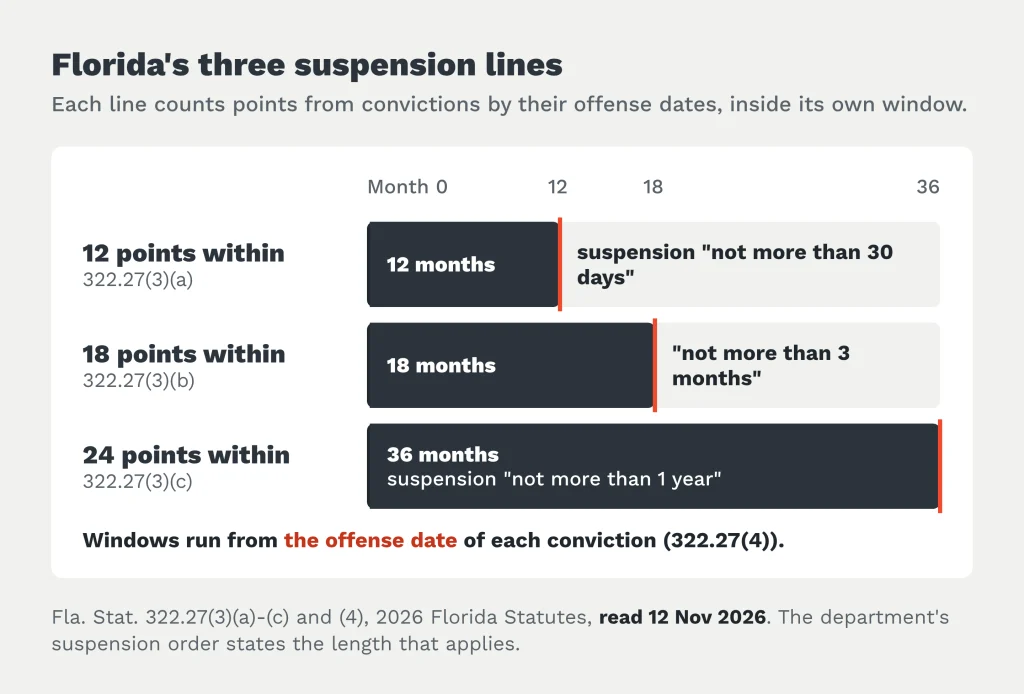
The DMV’s practice, kept separate. FLHSMV’s own points page gives these as flat periods: a 30-day suspension, a three-month suspension and a one-year suspension. (read on flhsmv.gov, 12 November 2026). The suspension order states the length that actually applies.
Before that point, the department “is authorized to send the licensee a warning letter” once a driver “reaches the danger zone” (322.27(3)(f)). The statute does not put a number on the danger zone.
Suspensions outside the point count. Some tickets bring a suspension or revocation whatever the point total (all read 12 Nov 2026):
- Crashes: the department may suspend, without a preliminary hearing, after a conviction for a traffic violation that caused a crash with death, personal injury or property damage over $500 (322.27(1)(b)). An infraction found at a mandatory hearing for a crash that caused a death carries a $1,000 civil penalty and a 6-month suspension. For serious bodily injury it is $500 and 3 months. When the injured or killed person is a “vulnerable road user”, the statute sets a civil penalty of not less than $5,000 and a 1-year suspension for a death, or not less than $1,500 and 3 months for serious bodily injury, plus a course (318.14(5)).
- Passing a stopped school bus again: the department may suspend, without a preliminary hearing, for a second or later violation of 316.172(1) within 5 years of any previous violation (322.27(1)(f)).
- On the court’s direction: the department must suspend when the convicting court directs it because it finds the seriousness of the offense warrants a suspension (322.27(2)).
- 50 mph or more over: section 318.14(13) applies to anyone cited for a violation of 316.1926. That section covers going 50 mph or more over the limit (316.1926(2)) and the offenses in 316.2085(2) and (3) (316.1926(1)). A first violation carries a $1,000 fine. A second carries $2,500, and the court revokes the license for 1 year. A third is a third-degree felony, with a $5,000 fine and a 10-year revocation (318.14(13)).
- Dangerous excessive speeding: a person convicted of a second or later violation of 316.1922 that occurs within 5 years after the date of a prior conviction under that section has the license revoked for “at least 180 days but no more than 1 year”. The 5 years run from the date of the prior conviction to the date of the new violation (316.1922(2)(b)).
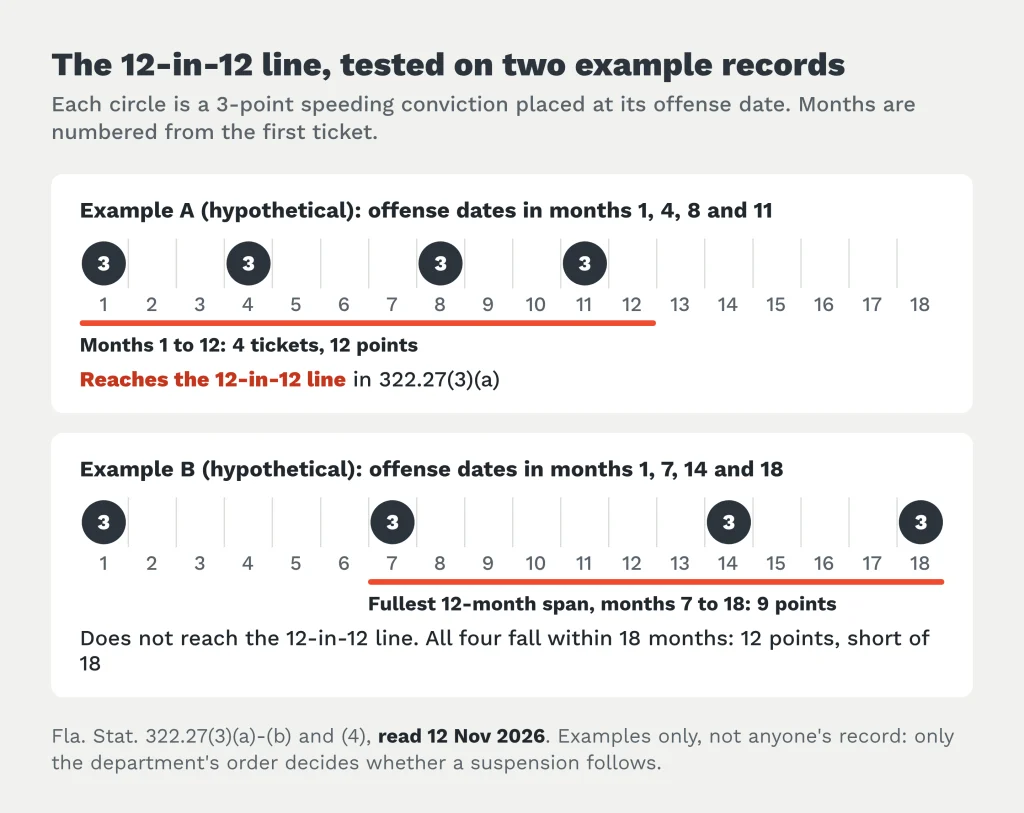
A worked example (hypothetical). An adult has four 3-point speeding convictions with offense dates in months 1, 4, 8 and 11 of the same year. That is 12 points within 12 months, which reaches the 12-in-12 line in 322.27(3)(a). Now suppose the offense dates were months 1, 7, 14 and 18. The fullest 12-month span (months 7, 14 and 18) holds 9 points, so the 12-in-12 line is not reached. All four fall within 18 months, but that is 12 points, short of 18, so that line is not reached either. The points and suspension checker runs this arithmetic on a driver’s own dates. Only the department’s order decides whether a suspension follows.
3. How long a ticket counts, how long it shows, and decay
People use “how long do points stay in Florida” for three different things. Florida’s answers are different for each, so we keep them apart. The general version is in how long points stay on your record.
| Question | What the source says | Source |
|---|---|---|
| The count window for a points suspension | 12, 18 and 36 months, using “the offense date of all convictions” | Fla. Stat. 322.27(3), (4), read 12 Nov 2026 |
| The window for habitual traffic offender status | A separate 5-year window (see below) | Fla. Stat. 322.264, read 12 Nov 2026 |
| How long points show on the driver record | No section we read sets it. FLHSMV’s points page says points “remain on the driver record for at least five years from the date of disposition (conviction)”. That is the department’s statement (flhsmv.gov, read 12 Nov 2026). The Driver License Check (below) shows the department’s own record. | FLHSMV points page, 12 Nov 2026; not in Fla. Stat. 322.27 or 318.14 |
| How long an unreinstated suspension for an unpaid or missed ticket shows | Stays on the department’s records for 7 years from the date imposed, then must be removed | Fla. Stat. 318.15(1)(a), read 12 Nov 2026 |
| Decay | None in 322.27. The one adjustment: 3 points come off the record of a person whose license was suspended “only once” under the point system and then reinstated, if all other requirements are met. | Fla. Stat. 322.27(3)(h), read 12 Nov 2026 |
4. What a course can do: the BDI election
Florida’s course works by keeping a conviction from happening, not by giving a credit afterwards. Section 318.14(9) lets an eligible driver “in lieu of a court appearance, elect to attend … a basic driver improvement course approved by” the department. When that happens, “adjudication must be withheld, any civil penalty that is imposed by s. 318.18(3) must be reduced by 18 percent, and points … may not be assessed”. A withheld adjudication “is not a conviction” (318.14(11)). The conditions, from 318.14(9) and 318.19 (read 12 Nov 2026):
- Once per 12 months: not available to anyone who made an election “in the preceding 12 months”.
- Eight in a lifetime: “A person may not make more than eight elections within his or her lifetime”.
- Not for commercial drivers: only for a person who “does not hold a commercial driver license or commercial learner’s permit” and who was driving a noncommercial vehicle.
- Not at 30 mph or more over: speeding under 316.183(2), 316.187 or 316.189 is excluded “when the driver exceeds the posted limit by 30 miles per hour or more”. Those tickets also need a court appearance (318.19(5)).
- Other exclusions: some license and registration offenses (320.0605, 320.07(3)(a)-(b), 322.065, 322.15(1)), and the commercial-vehicle offenses in 322.61 and 322.62 (all listed in 318.14(9)). Section 318.19 separately says the election is not available for any infraction that needs a mandatory hearing. That group covers crashes causing death or serious bodily injury, the school-bus offense in 316.172(1)(b), certain load violations, speeding 30 mph or more over (318.19(5)), and 50 mph or more over under 316.1926(2) (318.19(6)). The 50-mph item was added on 1 July 2025 by ch. 2025-77, Laws of Florida.
- Only for noncriminal infractions: the election belongs to section 318.14, and criminal traffic charges are outside chapter 318 (318.17).
If someone elects the course but doesn’t finish it in the time the court sets, the driver “is deemed to have admitted the infraction and shall be adjudicated guilty”. The 18 percent reduction must then be repaid, a processing fee of up to $18 applies, and “points shall be assessed” (318.15(1)(b)). Approved course providers must report completion to the department within 5 days. They must then send it to the county clerk within 3 days of receiving the completion certificate number (318.1451(6)(f)). The deadline for electing the course and the way to do it are on the citation and with the clerk of court for that county. Other states’ courses do different things, as traffic school by state shows.
Florida has other driver improvement courses, and none of them is a BDI election. The Advanced Driver Improvement course is required before reinstatement after a points suspension (322.291(2)). Separately, the department must order a course after certain crashes and after convictions for red-light, school-bus, racing or reckless-driving offenses. If that course is not finished within 90 days of the department’s notice, the license is canceled until it is (322.0261). Neither of these removes points. What an insurer may do with a BDI election is not in the sections we read.
5. When an FR-44 or SR-22 comes in
Florida’s statutes don’t use the names “SR-22” or “FR-44”. Those are FLHSMV’s names for the proof forms that chapter 324 requires. A speeding ticket on its own triggers neither. The general explainer is FR-44 in Florida and Virginia.
| Reason | What the statute requires | How long, and what starts the clock | Section |
|---|---|---|---|
| Found guilty of, or pleaded guilty or no contest to, DUI under 316.193 after 1 Oct 2007 (adjudication withheld or not) | Liability limits of $100,000 per person and $300,000 per crash for bodily injury, and $50,000 for property damage, or a certificate of deposit of at least $350,000 (FLHSMV calls this filing an FR-44) | “a minimum period of 3 years”. The person is exempt after 3 years “from the date of reinstatement” with no new DUI or felony traffic conviction | 324.023 |
| License or registration suspended or revoked for DUI or under 322.26(2) | Liability coverage on each vehicle registered to the person, as described in 627.7275(2), shown on a department form | Proof “to be maintained for 3 years”. The section does not name the start date | 324.131 |
| An unpaid crash judgment | The suspension lasts until the judgment is stayed or satisfied and proof of financial responsibility is given (FLHSMV calls this filing an SR-22) | Proof “to be maintained for 3 years”. The section does not name the start date | 324.131 |
| Suspension for having no required personal injury protection (PIP) or property damage coverage | Reinstatement fee of $150 the first time, $250 the second and $500 for each later one within 3 years of the first. Proof of coverage on a department form | Proof “shall be maintained for 2 years”. The section does not name the start date | 324.0221(3) |
| A points suspension alone | No filing requirement found in the sections we read | n/a | 322.27, 324 |
Lapses. An insurer must report the cancellation or nonrenewal of a PIP or property damage policy to the department within 10 days. The department suspends the license and registration “after due notice and an opportunity to be heard” (324.0221(1)-(2)). The sections we read contain no rule for the cancellation of an FR-44 or SR-22 filing itself. They also don’t say whether a lapse restarts the 3 years. The department’s letter controls.

Age, license type and tickets from other states
Ages 15 through 17. For a Class E licensee aged 15 to 17 with “six or more points … excluding parking violations, within a 12-month period”, the department “shall” restrict the license to business purposes only. The licensee must appear within 10 days after notice. The restriction lasts “no less than 1 year” from the date the department applies it. Each additional point adds 90 days. It is withdrawn after 1 year with no more points, or at 18 if no other grounds exist, and no administrative hearing is available (322.161, read 12 Nov 2026). Section 322.271(1)(c) defines “business purposes only” as driving needed to make a living, including work, school, church and medical trips.
Habitual traffic offenders. This status follows from three or more listed convictions within 5 years, from separate acts: DUI, driving while suspended or revoked, driving without a valid license, vehicle manslaughter, a felony using a vehicle, failing to stop and render aid after an injury crash, or driving a CMV while disqualified. Fifteen point-carrying moving convictions within 5 years also qualify (322.264). The department “shall revoke” the license, and the person is not eligible to be relicensed for “a minimum of 5 years from the date of revocation”, except as 322.271 provides (322.27(5)). Under 322.271(1)(b), a petition for reinstatement restricted to business or employment purposes may be made “upon expiration of 12 months from the date of such revocation”. Conviction on three reckless-driving charges committed within 12 months brings a mandatory revocation (322.26(6)).
CDL and CLP holders. They can’t elect BDI (318.14(9)). Federal law also bars any state from masking, deferring or diverting a CDL or CLP holder’s traffic conviction in any vehicle, parking, weight and defect violations aside (49 CFR 384.226, eCFR up to date as of 9 Nov 2026). Florida’s disqualification rules are in 322.61. Convictions for two serious violations in separate incidents, for offenses occurring within a 3-year period, bring a 60-day CMV disqualification, and three bring 120 days. The list includes speeding 15 mph or more over, reckless driving, improper lane changes, following too closely, texting and hand-held phone use. In a personal vehicle these count only “if such convictions result in the suspension, revocation, or cancellation” of the license. A single conviction for certain major offenses brings a 1-year CMV disqualification (3 years when hauling hazardous materials), among them leaving the scene of a crash, using a vehicle in a felony and DUI (322.61(3)-(4)). Convictions for two of those major offenses in separate incidents bring a permanent CMV disqualification (322.61(5)). Florida charges a $75 fee to reinstate a CDL after a disqualification (322.21(8)). More in traffic tickets and a CDL.
Tickets from other states. A conviction in another state for something that would be a Florida traffic violation “may be recorded against a driver on the basis of the same number of points” as a Florida conviction (322.27(3)(e)). Florida enacted the Driver License Compact in 322.44. Under Article IV, Florida must treat four out-of-state convictions as if they happened in Florida: vehicle manslaughter or negligent homicide, DUI, a felony using a vehicle, and failing to stop and render aid. For other convictions Florida applies its own law. The department may also suspend for an out-of-state offense that would be grounds in Florida (322.27(1)(e)). The BDI election is made in a Florida traffic case under 318.14, and nothing in 318.14(9) reaches a ticket decided in another state’s court.
Unpaid tickets and missed court dates
Florida still suspends for an unpaid or missed civil ticket. Within 30 days of the citation, a driver who doesn’t elect to appear must pay the civil penalty or enter a payment plan with the clerk (318.14(4)). The process starts if the driver doesn’t pay, doesn’t keep a payment plan, doesn’t attend driver improvement school or doesn’t appear at a hearing. The clerk must then notify the department within 10 days. The department issues a suspension order “effective 20 days after the date the order of suspension is provided”. The order must say that the clerk can set up a payment plan (318.15(1)(a)). A driver may ask for a hearing “within 180 days after the date upon which the violation occurred”, even after a suspension. If the 180th day falls on a weekend or legal holiday, the request is due within 177 days, though the court may grant a later request (318.15(1)(c)). Reinstatement needs the clerk’s certificate of compliance and a $60 service charge, which is not required when the $45 or $75 fee under 322.21(8) is paid (318.15(2), 322.29(2)).
Criminal traffic cases follow 322.245. If the court’s directives are not met in the time the court allows, the clerk sends a notice. The notice gives 30 days after its date to comply and pay a delinquency fee of up to $25. If that does not happen, the clerk notifies the department within 10 days, and the department’s suspension order takes effect 20 days after the order is provided (322.245(1), (3)).
Checking points and getting a license back
FLHSMV runs an official Driver License Check (official). Its points and point suspensions page (official) and driver improvement schools page (official) explain the department’s process. Tickets are paid to the clerk of court for the county named on the citation. We found no single statewide state payment page to link.
What the statutes require to reinstate after a points suspension (read 12 Nov 2026):
- The course: proof of enrollment in a department-approved Advanced Driver Improvement course before reinstatement (322.291(2)). Section 322.291(2) provides for cancellation when the course is not completed within 90 days after reinstatement, and 322.271(2)(a) says the same for a license reinstated on a restricted basis after a points suspension.
- The fee: a $45 service fee after a suspension or $75 after a revocation, plus the fee for a license (322.21(8)).
- Examinations: 322.29(1) says a suspended license is returned “after the applicant has successfully passed the vision, sign, and traffic law examinations”. Under 322.29(2), no examination is needed for a 318.15 or 322.245 suspension unless the chapter requires one elsewhere. The department’s letter says which steps apply.
- A hardship license: a driver may ask for a hearing on a restricted license for business or employment use. It is held “within not more than 30 days” after the request (322.271(1)(a)). For a points suspension the department requires proof of enrollment in the course (322.271(2)(a)). It may waive the hearing for someone enrolled in or finished with the course, though not for every case (322.271(2)(b)).
The steps in other states are in license reinstatement, state by state.
When people usually involve a lawyer
Most Florida tickets are noncriminal infractions (318.14(1)). Some charges are crimes, and people more often bring in a lawyer for those. Chapter 318 does not apply to the offenses in 318.17: fleeing a police officer, leaving the scene of a crash, DUI, reckless driving, a false crash report, refusing an officer’s lawful order, obstructing an officer, and any other criminal violation in chapter 316. Since 1 July 2025 “dangerous excessive speeding” (50 mph or more over, or 100 mph or more in a manner that threatens others) has been a crime punishable on a first conviction by up to 30 days in jail or a $500 fine, or both (316.1922). The same is true when a hearing is mandatory under 318.19, or when a deadline is running: the 30 days on the citation, the 180-day hearing request after a missed date, or a hardship hearing with the department. A crash with injury and a CDL at stake are two more common reasons.
The Florida courts’ statewide Self-Help Information pages mostly cover family-law forms. For a traffic case, the clerk of court for the county on the citation handles payment plans, course elections and hearing requests. The Florida Bar runs its own Lawyer Referral Service.
The next step
Read the citation or the department’s letter first. It gives the deadline, the county clerk, whether a court appearance is mandatory and, on a suspension order, the length and the steps. The Driver License Check shows the department’s record of points and status. Florida’s row sits beside the other states in points and suspension rules by state. The SR-22 and FR-44 period lookup shows Florida’s filing terms and what starts the clock, and the tickets and insurance rules lookup shows what Florida law says about insurers and tickets. Florida’s law is in section 322.27, section 318.14 and section 324.023 on the Legislature’s site.
Fact-check note. Statutes and rules checked on 12 November 2026: Fla. Stat. 316.1922, 316.1926, 318.14, 318.1451, 318.15, 318.17, 318.18, 318.19, 322.0261, 322.161, 322.21, 322.245, 322.26, 322.264, 322.27, 322.271, 322.29, 322.291, 322.44, 322.61, 324.0221, 324.023 and 324.131. All are from the 2026 Florida Statutes on the Florida Legislature’s Online Sunshine site, which shows “The 2026 Florida Statutes”. Also checked that day: ch. 2025-77, Laws of Florida (effective 1 July 2025), and 49 CFR 384.226 (eCFR up to date as of 9 November 2026). The 2025 edits to 322.27 (ch. 2025-6 and ch. 2025-155) changed cross-references and wording only, not points or thresholds. FLHSMV’s points page, its driver improvement schools page and its Driver License Check were read live on flhsmv.gov on 12 November 2026; the two statements attributed to FLHSMV (its fixed suspension periods and its at-least-five-years display period) are from that points page. The form names FR-44 and SR-22 are the department’s own, as used in its 19 December 2007 bulletin to insurers (read on flhsmv.gov, 12 November 2026). The Florida Bar’s referral service page could not be opened on 12 November 2026; its address was confirmed in an Internet Archive capture of 25 October 2026.
Sources
- Fla. Stat. 322.27 (2026 Florida Statutes)
- Fla. Stat. 318.14
- Fla. Stat. 318.15
- Fla. Stat. 318.17
- Fla. Stat. 318.19
- Fla. Stat. 318.1451
- Fla. Stat. 316.1922
- Fla. Stat. 322.0261
- Fla. Stat. 322.161
- Fla. Stat. 322.21
- Fla. Stat. 322.245
- Fla. Stat. 322.26
- Fla. Stat. 322.264
- Fla. Stat. 322.271
- Fla. Stat. 322.29
- Fla. Stat. 322.291
- Fla. Stat. 322.44 (Driver License Compact)
- Fla. Stat. 322.61
- Fla. Stat. 324.0221
- Fla. Stat. 324.023
- Fla. Stat. 324.131
- Laws of Florida ch. 2025-77 (dangerous excessive speeding)
- 49 CFR 384.226 (eCFR)
- FLHSMV: Points and point suspensions
- FLHSMV: Driver License Check
- Fla. Stat. 316.1926
- Fla. Stat. 318.18
- FLHSMV: Points and point suspensions
- FLHSMV bulletin to insurers on FR-44 filings, 19 Dec 2007