Not owning a car does not, by itself, end an SR-22 requirement. In the states whose laws we read, the certificate can rest on an “operator’s policy” (Virginia calls it a “driver’s policy”): liability insurance that follows you, the named driver, into vehicles you don’t own, instead of covering a particular car. That pairing is what people mean by a non-owner SR-22. The state decides whether you need the filing and for how long; the insurer files the certificate; the policy behind it is the operator’s kind. This page sets out what the law says about each piece. For the filing in general, start with what an SR-22 is; every SR-22 and FR-44 page is listed in the SR-22 and FR-44 guide.
This page is general information about the law, not legal advice and not a substitute for the advice of an attorney. Traffic, license and SR-22 rules vary by state and change. The court’s or the DMV’s own letter controls.
The short version
- The law allows it: Texas, Florida, Washington, California and Virginia law each accept an operator’s (non-owner) policy as proof, and define it as covering the named person’s use of a vehicle that person does not own (sections and read dates below).
- Owning no car is not an exit: Oregon DMV says you must file an SR-22 “even if you don’t own a vehicle” (DMV page, read 12 November 2026).
- It does not cover a car you own: if you register a vehicle while the requirement runs, the Texas and Virginia statutes require proof for that vehicle too.
- How long: the same term as any SR-22 in that state, often depending on the reason: 1 year in Ohio and Kansas; in Texas the proof may be released on request after 2 years, on conditions; 3 years in several of the states we read; each counted from its own starting point. No national rule exists.
What a non-owner SR-22 is
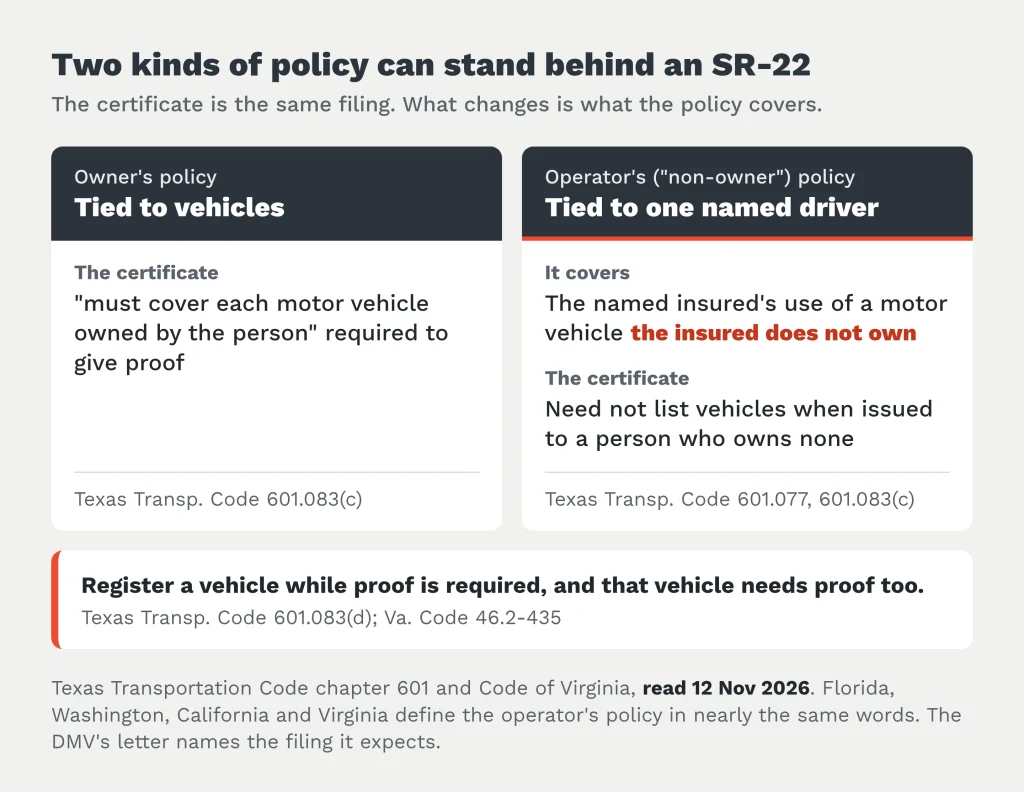
Two separate things are bundled in the phrase. The SR-22 is a certificate an insurer files with the state saying a liability policy is in force for a driver the state has told to show “proof of financial responsibility” for the future. The policy behind that certificate can be of two kinds in most financial-responsibility laws: an owner’s policy, which covers listed vehicles and the people driving them with permission, or an operator’s policy, which covers one named person in vehicles that person does not own. “Non-owner” is the everyday name for the second kind; the statutes say “operator’s policy”.
Texas law states it directly. An operator’s policy “must pay, on behalf of the named insured, amounts the insured becomes obligated to pay as damages arising out of the use by the insured of a motor vehicle the insured does not own, subject to the same territorial limits, payment limits, and exclusions as for an owner’s policy” (Texas Transportation Code 601.077, read 12 November 2026). And the certificate the insurer files “must cover each motor vehicle owned by the person required to provide the evidence of financial responsibility, unless the policy is issued to a person who does not own a motor vehicle” (601.083(c), same read).
Oregon DMV’s own page names the certificate types an insurer can file: an Owner certificate, where the person owns the vehicles the policy covers; an Operator certificate, where the person “does not own the vehicle(s) covered by the insurance policy”; and an “on behalf of” certificate, which a vehicle owner files for an employee or immediate family member, who may then drive only the vehicle on the owner’s policy. Oregon DMV says an “on behalf of” SR-22 is an operator certificate (Oregon DMV, SR-22 Information, read 12 November 2026).
What the statutes say it covers
The states we read use almost the same words. Each sets the minimum the policy must do once it is certified as proof; the limits are the state’s own minimums for an owner’s policy.
| State | Name in the law | What it must cover (as written) | Section, read |
|---|---|---|---|
| Texas | Operator’s policy | The named insured’s use “of a motor vehicle the insured does not own” | Transp. Code 601.077, 12 Nov 2026 |
| Florida | Operator’s motor vehicle liability policy | Damages “arising out of the use by the person of any motor vehicle not owned by him or her” | Fla. Stat. 324.151(1)(b), 12 Nov 2026 |
| Washington | Operator’s policy | The named person’s use “of any motor vehicle not owned by him or her” | RCW 46.29.490(3), 12 Nov 2026 |
| California | Operator’s policy | Use “of any motor vehicle not owned by that person”, plus a newly bought vehicle “for a period not to exceed 10 days from date of purchase” | Veh. Code 16452, 12 Nov 2026 |
| Virginia | Driver’s policy | The named person’s use “of any motor vehicle not owned by him” | Va. Code 46.2-473, 12 Nov 2026 |
California’s definition allows “an owner’s policy or an operator’s policy, or both” to be certified as proof (Veh. Code 16450, read 12 November 2026). Virginia DMV’s FR-44 certificate form shows how the choice reaches paper: the insurer ticks either “Owner’s policy”, listing each vehicle by year, make and VIN, or “Operator’s policy”, described as “applicable to any vehicle not registered/titled to the above listed person” (Virginia DMV form FR 44, dated 01/01/2008, read 12 November 2026).
What the statutes don’t settle
The statutes set a floor, not the whole contract. Texas lets a policy add “lawful coverage in excess of or in addition to the required coverage” and says that extra part is not governed by the chapter (601.078). Florida’s required terms apply to a policy only “until it is furnished as proof of financial responsibility for the future” and from then on (324.151(2)). Questions such as whether a particular policy covers a car someone in your household owns, or a car you drive every day but don’t own, turn on that policy’s own wording, which the statutes we read don’t spell out.
Owning no car doesn’t end the requirement
The requirement attaches to the driver, not to a vehicle. Oregon DMV puts it plainly: “You are required to file an SR-22 even if you don’t own a vehicle. You must maintain the SR-22 filing until the requirement ends. DMV must suspend your driving privileges if you fail to file an SR-22” (Oregon DMV page, read 12 November 2026). Texas DPS’s SR-22 questions and answers say the same: a person who owns no vehicle must still file and keep an SR-22 and may get a non-owner policy for it (DPS SR-22 FAQ, read 12 November 2026).
The statutes do name ways the requirement ends early, and none of them is “I sold my car”. In Texas the state may cancel or waive the proof if the person dies, becomes permanently unable to drive, or “surrenders the person’s license and vehicle registration to the department” (601.056(b)(2)-(3)). Virginia has the same three events, with surrender of the license, “all of his registration cards, and license plates” (Va. Code 46.2-460, read 12 November 2026). Washington adds a catch: a person who surrendered the license and applies again within three years of when proof was first required must “reestablish such proof for the remainder of such three-year period” (RCW 46.29.600(3), read 12 November 2026). Texas (601.056(g)), Illinois, South Carolina (S.C. Code 56-9-630, read 12 November 2026) and Utah have similar rules for the rest of the period (see the lapse section).

If you buy or register a car
An operator’s policy covers vehicles you don’t own, so owning one changes what the proof has to cover. The statutes we read:
- Texas: “A motor vehicle may not be registered in the name of a person required to provide evidence of financial responsibility unless the vehicle is covered by a certificate” (601.083(d), read 12 November 2026).
- Virginia: proof “shall be furnished for each motor vehicle registered by the person required to furnish such proof” (Va. Code 46.2-435, read 12 November 2026).
- Washington: the insurer’s certificate must “designate by explicit description or by appropriate reference all vehicles covered thereby, unless the policy is issued to a person who is not the owner of a motor vehicle” (RCW 46.29.460, read 12 November 2026).
- California: the operator’s policy itself reaches a newly bought vehicle for no more than 10 days from the date of purchase (Veh. Code 16452).
- Florida: after a DUI suspension or revocation, or one under 322.26(2), the person “shall maintain liability coverage for each motor vehicle registered in his or her name” and show it on the department’s form, “such proof to be maintained for 3 years” (Fla. Stat. 324.131, read 12 November 2026).
Texas also lets a later certified policy replace an earlier one: “A policy that is obtained and certified terminates a previously certified policy on the effective date of the certification of a subsequent policy” (601.085(b)). Washington’s equivalent applies “with respect to any vehicle designated in both certificates” (RCW 46.29.500).
If you live in another state
The filing goes to the state that imposed the requirement, and the states differ on which insurers may file it. Texas lets “a nonresident who does not own a motor vehicle” file the certificate of an insurer authorized in the state where the nonresident lives, if that insurer agrees to be served in Texas and to treat its policies as meeting Texas law (601.084(b)-(c), read 12 November 2026). Washington has the same rule for a nonresident who “does not own a vehicle” (RCW 46.29.470). Oregon DMV, by contrast, says an SR-22 filed with it “must be issued by an insurance company doing business in Oregon”, that you must file with Oregon DMV even if you live out of state, and that another state may not issue you a license while Oregon has you suspended for failing to file (Oregon DMV page, read 12 November 2026). In the texts we read, the filing stays with the state that set the requirement, wherever you live.
The local names: FR-44, DL-123 and states with none
- Florida FR-44. After being found guilty of, or pleading guilty or no contest to, DUI after 1 October 2007, “every owner or operator” must carry $100,000 / $300,000 / $50,000, for “a minimum period of 3 years”. The section stops applying once the person has had no DUI or felony traffic conviction for 3 years from reinstatement. A certificate of deposit must be at least $350,000 (Fla. Stat. 324.023, read 12 November 2026). The section names operators as well as owners. See FR-44 in Florida and Virginia.
- Virginia FR-44. Virginia’s form is for coverage “double the minimum limits generally required by Virginia Code §46.2-472” under 46.2-316 C, and it has an operator’s-policy box (FR 44 form, read 12 November 2026). Va. Code 46.2-316(C) says “not less than double” those minimums. For policies effective on or after 1 January 2025 the 46.2-472(B) minimums are $50,000 / $100,000 / $25,000 (46.2-316 and 46.2-472, read 12 November 2026), so the FR-44 floor is $100,000 / $200,000 / $50,000.
- North Carolina DL-123. Proof of insurance kept 3 years after restoration after certain revocations (G.S. 20-19(k), 20-13.2(e), read 11 November 2026).
- New York: none. “Notwithstanding any other provision of law, no person, on and after February first, nineteen hundred fifty-seven, shall be required to file or maintain proof of financial responsibility pursuant to this article” (VTL 346, read 12 November 2026). Instead, when proof of insurance for a registered vehicle is no longer in effect, the commissioner suspends the vehicle’s registration and the registrant’s license, with exceptions set out in the section (VTL 318(1), read 12 November 2026).
- Pennsylvania: none as such. PennDOT asks for proof of insurance when it restores a license or registration (75 Pa.C.S. 1783-1786, read 11 November 2026).
- Kansas: after a conviction listed in K.S.A. 8-285, the insurer keeps evidence of insurance on file with the state for 1 year (K.S.A. 40-3118(d), read 12 November 2026).
How long it lasts, by state
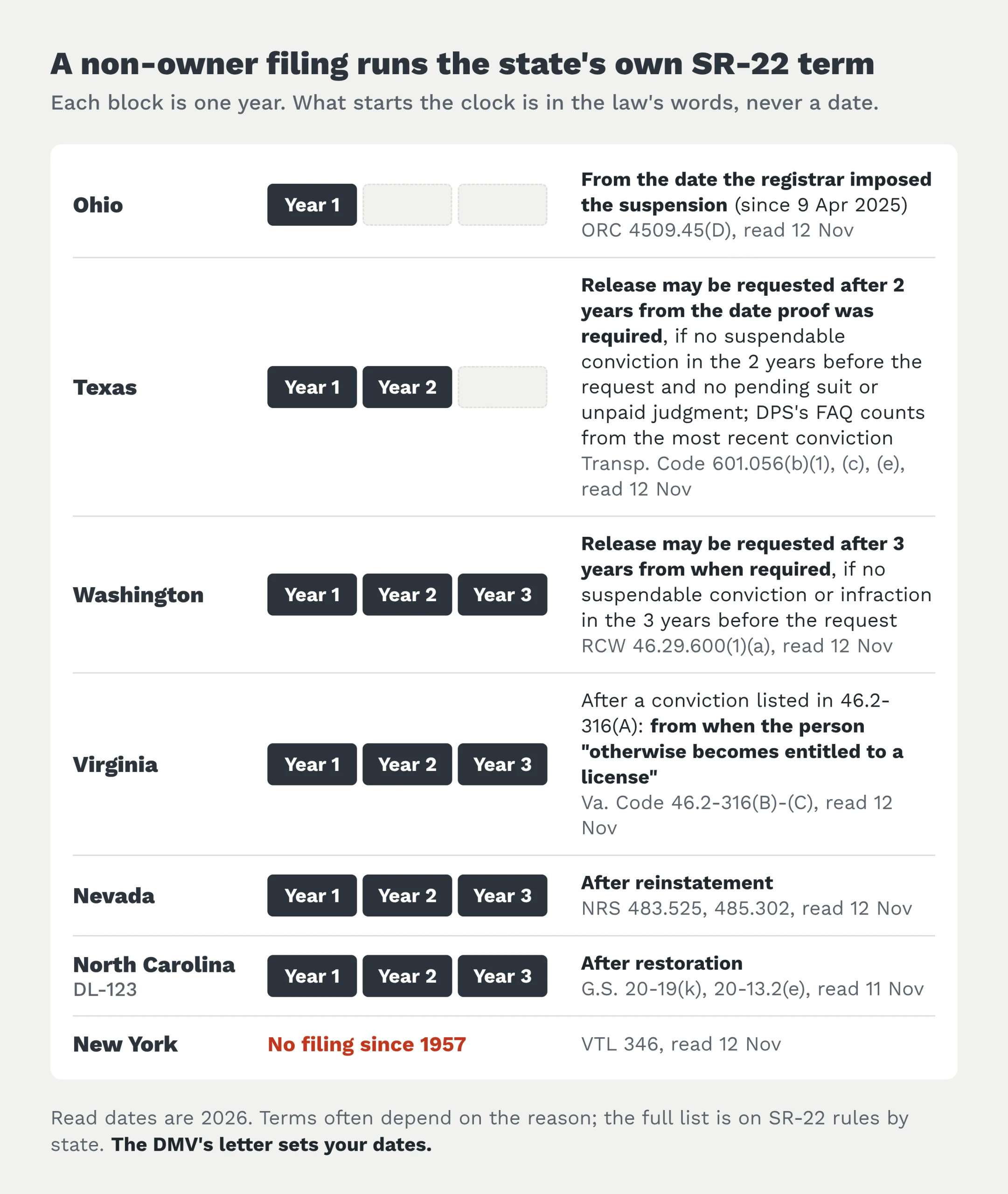
A non-owner filing lasts as long as any SR-22 in that state: the term depends on the state and often on the reason, and what starts the clock differs. Never one date for everyone; the DMV’s letter gives yours. The full 51-state list is on SR-22 rules by state, and the SR-22 period lookup shows a state’s rule in words.
| State | Term, in the law’s words | Clock starts | Section, read |
|---|---|---|---|
| California | DMV shall on request, or may on its own, cancel the proof “at any time after three years from the date the proof was required”; 3 years after a negligent-operator reinstatement | Date required; reinstatement | Veh. 16480(a)(2), 12810.5(c); 12 and 11 Nov |
| Colorado | 3 years from when last required; after a first DUI or DWAI with no crash, the length of the restraint, at most 3 years | When last required | C.R.S. 42-7-408(1)(b); 11 Nov |
| Florida | SR-22 proof 3 years; FR-44 at least 3 years | Not stated; the FR-44 exemption counts 3 years from reinstatement | 324.131, 324.023; 12 Nov |
| Illinois | 3 years | First filing | 625 ILCS 5/7-304, -305 (12 Nov), -310 (11 Nov) |
| Maryland | Not confirmed | Not confirmed | MVA pages not read |
| Nevada | 3 years after reinstatement | Reinstatement | NRS 483.525, 485.302; 12 Nov |
| New Jersey | Not confirmed (MVC asks for proof of current insurance) | Not confirmed | MVC page; statute not read |
| New York | No filing since 1957 | n/a | VTL 346; 12 Nov |
| North Carolina | DL-123 for 3 years after restoration | Restoration | G.S. 20-19(k), 20-13.2(e); 12 Nov |
| Ohio | 1 year (since 9 Apr 2025) | Date the registrar imposed the suspension | ORC 4509.45(D); 12 Nov |
| Oregon | 1 year after an 806.200 or 806.230 requirement; 3 years otherwise | When required | ORS 806.245; 11 Nov |
| Pennsylvania | None as such | n/a | 75 Pa.C.S. 1783; 11 Nov |
| South Carolina | May be released on request after 3 years, if no suspendable conviction is on record in the 3 years before the request | Date proof was required | S.C. Code 56-9-620(1), -630; 12 Nov |
| Texas | May be released on request after the 2nd anniversary of the date proof was required, if DPS has no suspendable conviction on record in the 2 years before the request (and not while a damages suit on a liability the proof covers is pending or a judgment on one is unpaid, 601.056(e)); DPS’s FAQ counts 2 years from the most recent conviction | Date proof was required (statute); most recent conviction (DPS) | Transp. 601.056(b)(1), (c), (e); DPS FAQ; 12 Nov |
| Virginia | 3 years, after a conviction listed in 46.2-316(A); other reasons are set in other sections | When the person “otherwise becomes entitled to a license” | Va. Code 46.2-316(B)-(C); 12 Nov |
| Washington | May be released on request at any time after 3 years from when required, if no conviction or infraction that would allow a suspension is on record in the 3 years before the request | When required | RCW 46.29.600; 12 Nov |
Lapses: what the insurer must tell the state
An SR-22 works because the insurer has to tell the state when the certified policy ends. Virginia DMV’s insurance certifications page pairs the SR-22 with an SR26 and the FR-44 with an FR-46 (Virginia DMV, financial responsibility certifications, read 12 November 2026). The statutes set how quickly:
- Texas: the certified policy “may not be terminated before the sixth day after the date a notice of the termination is received by the department” (601.085(a), read 12 November 2026).
- Washington: not cancelled “until at least ten days after a notice” is filed with the department (RCW 46.29.500, read 12 November 2026).
- Virginia: the insurer reports a cancellation “within fifteen days after the cancellation” (Va. Code 46.2-482, read 12 November 2026).
- Illinois 15 days’ notice (7-315(b)); Ohio not ended until 10 days after notice (4509.57); North Carolina 20 days (20-279.22). Nevada’s DMV must suspend if the policy ends within the 3 years (NRS 483.525). California suspends until new proof is filed (Veh. 16484). Illinois and North Carolina read 11 November 2026, the others 12 November 2026.
Whether a lapse restarts the whole term is a common question. We found that in no statute we read. What the texts do say: Texas law says that when the evidence on file stops doing its job, DPS “shall suspend” the license and all vehicle registrations until other evidence is filed (601.057, read 12 November 2026), and Texas DPS describes a lapse as leading to a new suspension, a new SR-22 and a $100 reinstatement fee (DPS FAQ; the fee is in 601.376); Texas, Washington, Illinois, South Carolina and Utah make a person who surrendered a license re-establish proof for the rest of the period. If your letter says something about the clock, the letter controls.
What it costs, and what the law sets
Three costs are in play, and the law sets only one. The reinstatement fee is in statute: Texas $100 for a suspension under chapter 601 (601.376, read 12 November 2026); Florida $45 after a suspension and $75 after a revocation, on top of the license fee, with an extra $130 when the suspension or revocation was for DUI or a test refusal (Fla. Stat. 322.21(8), read 12 November 2026); Illinois $70 after a suspension and $500 after a revocation (625 ILCS 5/6-118(b), read 12 November 2026); Washington $75 to reissue, or $170 after a DUI or implied-consent suspension or revocation, with exceptions the section lists (RCW 46.20.311, read 12 November 2026); Colorado $95 to restore (C.R.S. 42-2-132(4), read 11 November 2026). The insurer’s charge to file the certificate and the premium for the operator’s policy are not set in any statute we read, and we don’t publish insurers’ figures. See license reinstatement, state by state for the steps.
Insurance isn’t the only proof the statutes allow. Texas accepts a $55,000 deposit of cash or securities with the comptroller, or a bond with real-property sureties (601.121, 601.122); Virginia lists a policy, a bond, a deposit or a self-insurance certificate (Va. Code 46.2-436); Washington lists the same four (RCW 46.29.450). All three read 12 November 2026.
Claims you may see elsewhere
- “No car, no SR-22.” We checked this against the texts and it isn’t what they say: Oregon DMV and Texas DPS both say the requirement stands without a vehicle, and the statutes build in an operator’s policy for exactly that case.
- “A non-owner SR-22 covers any car you drive.” The statutes say any vehicle “not owned by” you. Other limits come from the policy’s own wording, which the statutes don’t fix.
- “An SR-22 is always 3 years.” Ohio is 1 year since 9 April 2025 and Kansas 1 year; in Texas the proof may be released on request after 2 years, on conditions; New York has none at all (rows above).
- “A lapse resets the clock.” Not in any statute we read; see the lapse section.
Your next step
- Read the DMV or court letter: it names the filing (SR-22, FR-44, DL-123), the reason, and the date by which proof must reach the agency. That letter, not this page, sets your dates.
- Find your state’s row, with its statute and read date, in the 51-state SR-22 table or the period lookup linked above, and open the DMV’s own page from there.
- The certificate comes from an insurer, not from you. Which insurers a state accepts is set by that state: Oregon DMV says one doing business in Oregon, while the Texas and Washington statutes also accept a nonresident non-owner’s home-state insurer on conditions (sections above). The DMV’s letter or page names the filing it expects.
- Check later that the filing is on record, and when the requirement ends, through the DMV’s official status page: see how to check your license status and record.
Statutes and rules checked on 12 November 2026, except where a row says 11 November 2026. Texas Transportation Code chapter 601 as published on the Texas Legislature’s statutes site; Florida Statutes 2026 (Florida Legislature); Code of Virginia pages dated 11/12/2026; Revised Code of Washington chapter 46.29 as published by the Code Reviser; California Vehicle Code 16450-16452 on leginfo; New York VTL 346 on the New York State Senate site; Oregon DMV’s SR-22 page, Virginia DMV’s FR 44 form and certifications page, South Carolina Code chapter 56-9 and K.S.A. 40-3118 as read that day. Read on 12 November 2026: Ohio R.C. 4509.45(D) and 4509.57 on codes.ohio.gov; North Carolina G.S. 20-19(k) and 20-13.2(e) on ncleg.gov; Nevada NRS 483.525 and 485.302 on the Legislature’s site; Illinois 625 ILCS 5/7-304 and 7-305 in the General Assembly’s official ILCS files; Texas DPS’s SR-22 FAQ. Read 11 November 2026: Oregon ORS 806.245, Illinois 7-310, and the Colorado and Utah rows. Not read: Illinois, Ohio and Nevada operator’s-policy sections, New Jersey’s financial-responsibility statute and Maryland’s MVA pages. Found an error? See corrections.
Sources
- Texas Transportation Code chapter 601 (601.051, 601.056, 601.077, 601.078, 601.083-.085, 601.121, 601.122, 601.376), Texas Legislature
- Florida Statutes 2026, 324.151 (operator's policy)
- Florida Statutes 2026, 324.023 (FR-44 limits)
- Florida Statutes 2026, 324.131 (period of proof)
- Florida Statutes 2026, 322.21(8) (reinstatement fees)
- Revised Code of Washington 46.29.490 (owner's and operator's policy)
- Revised Code of Washington 46.29.460, .470, .500, .600
- California Vehicle Code 16452 (operator's policy)
- Code of Virginia 46.2-473 (driver's policy)
- Code of Virginia 46.2-435 (proof for each registered vehicle)
- Code of Virginia 46.2-436 (methods of proof)
- Code of Virginia 46.2-460 (cancellation of proof)
- Code of Virginia 46.2-472 (owner's policy minimums)
- Code of Virginia 46.2-482 (insurer's cancellation report)
- Virginia DMV, FR 44 Uniform Financial Responsibility Certificate (01/01/2008)
- Oregon DMV, SR-22 Information
- New York Vehicle and Traffic Law 346, New York State Senate
- Virginia DMV, financial responsibility certifications
- South Carolina Code chapter 56-9
- Kansas Statutes 40-3118
- Revised Code of Washington 46.20.311
- Code of Virginia 46.2-316