New York counts license points by the date of the violation, and since 16 February 2026 it looks back 24 months, not 18. Under the DMV’s point rule, 15 NYCRR 131.4(c), a driver with 11 or more points in 24 months, 9 or more points from speeding in 24 months, or 4 or more new points within 12 months after a DMV hearing may be required to attend a formal hearing “at which suspension or revocation action may be taken.” The rule sets no suspension length. Separately, the Vehicle and Traffic Law requires revocation after a third speeding or misdemeanor traffic conviction for violations within 18 months (VTL 510(2)(a)(iv)), with no new license for at least six months (VTL 510(6)(a)). This page is part of our traffic rules by state series.
This page is general information about the law, not legal advice and not a substitute for the advice of an attorney. Traffic, license and SR-22 rules vary by state and change. The court’s or the DMV’s own letter controls.
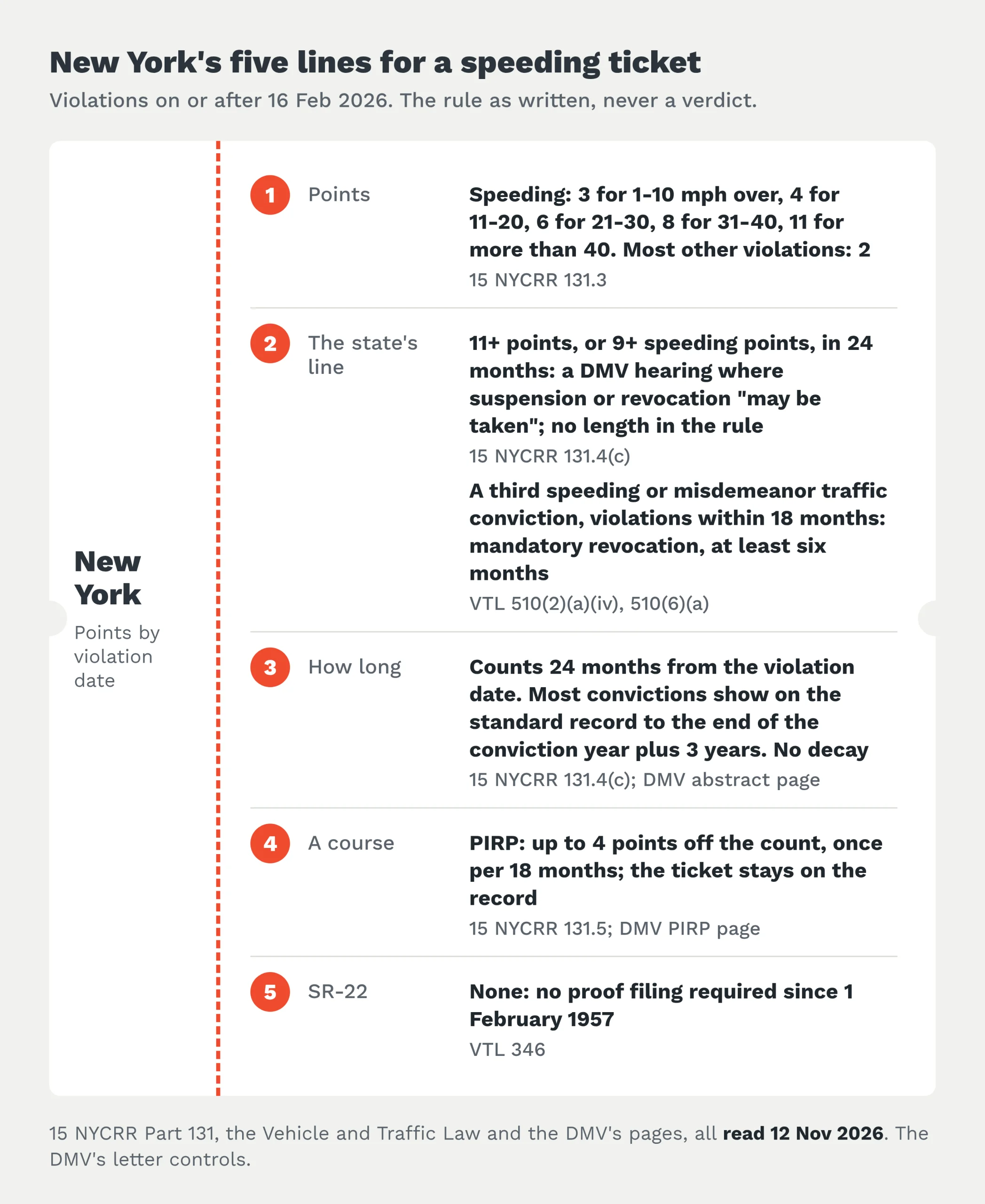
New York in five lines
- Points: 3 for speeding 1-10 mph over, 4 for 11-20, 6 for 21-30, 8 for 31-40, 11 for more than 40, 8 for speeding in a work zone; 2 for most other moving violations (15 NYCRR 131.3).
- The line: 11+ points in 24 months, or 9+ speeding points in 24 months, can lead to a DMV hearing where the license may be suspended or revoked; the rule gives no length (131.4(c)). A third speeding or misdemeanor traffic conviction for violations within 18 months means mandatory revocation, at least six months (VTL 510(2)(a)(iv), 510(6)(a)).
- How long: points count for 24 months from the violation date; most convictions show on the standard DMV record until the end of the year of conviction plus 3 years (DMV); no decay rule.
- A course: an approved Point and Insurance Reduction Program course takes up to 4 points off the count, for violations in the 18 months before you finish, once per 18 months (131.5).
- SR-22: none. No one has had to file proof of financial responsibility under New York’s old proof article since 1 February 1957 (VTL 346).
Sources: 15 NYCRR Part 131 on the online NYCRR (govt.westlaw.com/nycrr), “current through September 30, 2025”, and the Vehicle and Traffic Law on nysenate.gov, both read 12 November 2026.
What changed on 16 February 2026
The DMV adopted amendments to 15 NYCRR 131.3 and 131.4 on 6 November 2024, published a notice in the State Register on 14 January 2026, and made them enforceable from 16 February 2026. Its memo to courts and police (DMV memo P 2 / M 1 (2026), dated 30 January 2026, read 12 November 2026) says two things changed:
- Point values, by violation date. Rule 131.3(c) says points are “assessed as of the date of violation.” Violations on or after 16 February 2026 carry the new values; violations on or before 15 February 2026 keep the old ones.
- The look-back. The period in which DMV may act on persistent violation went from 18 months to 24 months, beginning 16 February 2026.

| Violation (VTL section) | Violation on or before 15 Feb 2026 | Violation on or after 16 Feb 2026 |
|---|---|---|
| DWI, DWAI, aggravated DWI, DWAI drugs (1192) | 0 | 11 |
| Aggravated unlicensed operation, 1st, 2nd or 3rd degree (511) | 0 | 11 |
| Passing a stopped school bus (1174) | 5 | 8 |
| Speeding in a construction zone (1180(f)) | Based on speed | 8 |
| Over-height vehicles (385(2), (14)) | 0 | 8 |
| Leaving the scene of a personal injury crash (600(2)) | 3 | 5 |
| Failure to exercise due care (1146) | 2 | 5 |
| Facilitating aggravated unlicensed operation (511-a) | 0 | 5 |
| Speed contests and races (1182) | 0 | 5 |
You may see two older numbers on other sites: “11 points in 18 months” and “10 points.” We checked both against the rule. The 18-month look-back ended on 16 February 2026, and the rule text says “eleven or more points” (131.4(c)(1)). The rule also adds a separate line for 9 or more points from speeding (131.4(c)(2)).
One point the memo doesn’t settle: how the 24-month look-back treats a mix of violations from before and after 16 February 2026. The memo says the calculation changes “beginning February 16, 2026”; neither it nor the rule spells out the mixed case. If you have tickets on both sides of that date, the DMV’s own letter is the only reliable answer.
Points per violation
New York has its own driver point system, set by the DMV’s rule rather than by statute (other states’ lines are in points and suspension rules by state). Every violation is 2 points “except as otherwise prescribed” (131.3(a)). Points go on the record only after a conviction or a bail forfeiture is reported to DMV (131.2). The schedule for violations on or after 16 February 2026, from 15 NYCRR 131.3(b), read 12 November 2026:
| Points | Violations (131.3(b)) |
|---|---|
| 11 | Speeding more than 40 mph over the limit; driving while suspended or revoked, including VTL 511; any alcohol- or drug-related driving conviction or incident |
| 8 | Speeding more than 30 but not more than 40 mph over; passing a stopped school bus; over-height vehicles and bridge strikes (VTL 385(2), (14)); speeding in a work zone over the posted work-area limit (VTL 1180(f)) |
| 6 | Speeding more than 20 but not more than 30 mph over |
| 5 | Reckless driving; mobile phone or portable electronic device use; railroad crossing violations; facilitating aggravated unlicensed operation; failure to exercise due care (VTL 1146); speed contest or race (VTL 1182); leaving the scene of a personal injury crash |
| 4 | Speeding more than 10 but not more than 20 mph over; following too closely; inadequate service brakes (2 points when committed by an employed driver during the course of employment) |
| 3 | Any other speed violation “except where a different point value has been assigned” (the DMV’s point-system page lists 1-10 mph over and speeding with no mph stated here); failure to yield; traffic signal, stop or yield sign; improper passing, unsafe lane change, left of center or wrong direction; leaving the scene of a property-damage incident or injury to an animal; child under 16 not belted or in a car seat |
| 2 | All other traffic violations |
| 0 | Registration, licensing and insurance violations; inspection, weight, size and equipment (except brakes); parking; pedestrian and bicycle; business-related violations; anything not from driving a vehicle; the Suffolk County HOV lane rule on the Long Island Expressway |
Points and fines are separate. For an ordinary speeding conviction, VTL 1180(h)(1) sets a fine of $45 to $150 for not more than 10 mph over, $90 to $300, up to 15 days in jail, or both for more than 10 but not more than 30 over, and $180 to $600, up to 30 days, or both for more than 30 over; school and work zones carry higher ranges (1180(h)(3), (4)), and the maximum fine can rise by $150 for a second speeding violation, or $375 for a third, where the violations were committed within 18 months (1180(h)(5)). A mandatory surcharge and crime victim assistance fee are added under VTL 1809. The court sets the amount within these ranges.
The suspension line
New York has two separate routes from tickets to losing a license: the DMV’s point rule, where action is possible but not automatic and has no fixed length, and the statute’s mandatory revocations and suspensions, which do have minimums. Read each on its own.
The point rule: 15 NYCRR 131.4
| Points (window) | What the rule says DMV may do | Section |
|---|---|---|
| 4 to 6 in 24 months | Mail a letter on the status of the record and possible future action | 131.4(a) |
| 7 to 10 in 24 months | Require a driver improvement clinic; not attending “may result in the suspension” of the license under Part 132 | 131.4(b) |
| 11 or more in 24 months | Require a formal hearing “at which suspension or revocation action may be taken”; not when all the points come from one alcohol- or drug-related incident or one VTL 511 conviction | 131.4(c)(1) |
| 9 or more from speeding in 24 months | The same formal hearing | 131.4(c)(2) |
| 4 or more additional points within 12 months after attending a formal hearing | The same formal hearing | 131.4(c)(3) |
| Three or more point violations charged in “an unusually short period of time” | A formal hearing even below those totals, in the commissioner’s discretion | 131.4(d) |
| One 11-point violation | A hearing on that violation under VTL 510(3)(a), not a persistent-violator hearing | 131.4(e) |
The rule says “may” throughout. It sets the point totals at which DMV can call a hearing; it does not say a hearing ends in a suspension, and it gives no suspension length. The DMV’s own point-system page puts it as “If you get 11 points in 24 months, your driver license may be suspended” (read 12 November 2026). If a hearing is scheduled, the notice says when and where, and any order that follows states the period.
Worked example (hypothetical)
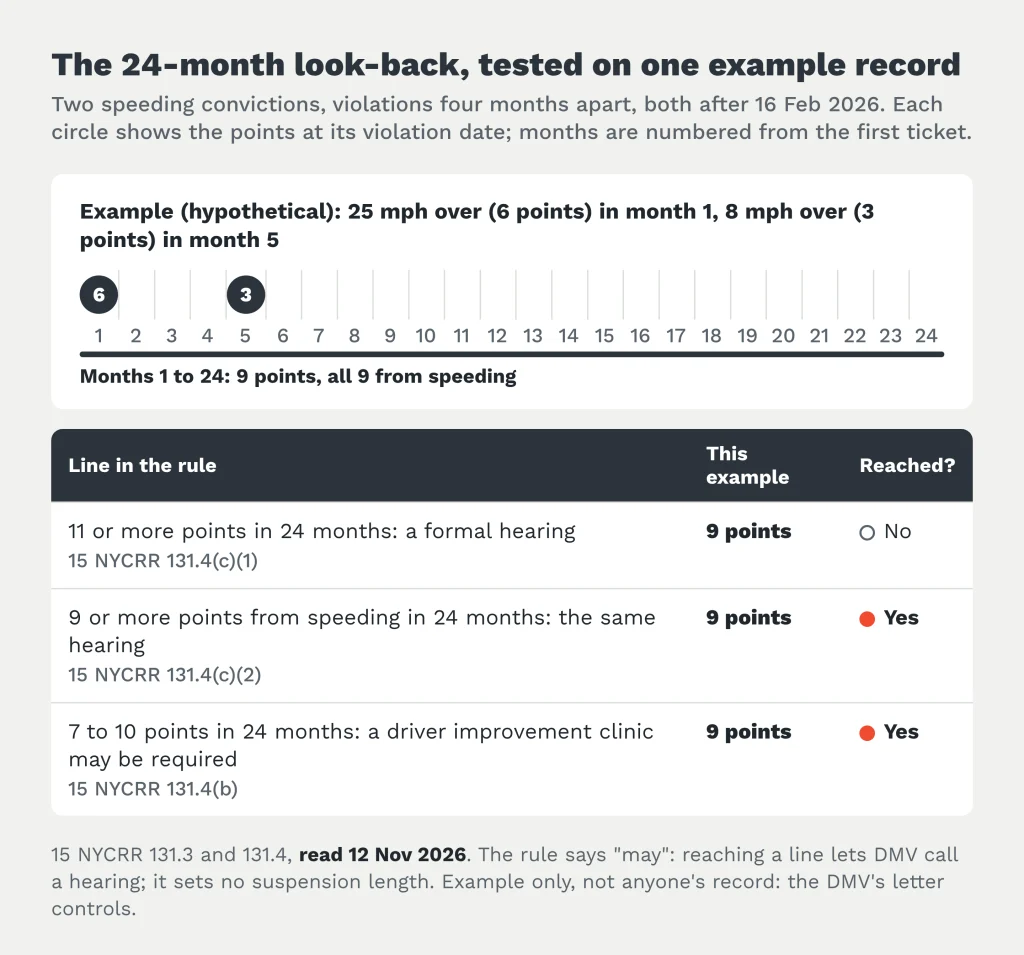
An adult driver is convicted of two speeding tickets for violations four months apart, both after 16 February 2026: 25 mph over (6 points) and 8 mph over (3 points).
- Total points in 24 months: 6 + 3 = 9. That does not reach the 11-point line in 131.4(c)(1).
- Points from speeding in 24 months: 9. That reaches the 9-speeding-point line in 131.4(c)(2), so the rule allows DMV to call a hearing.
- Nine points also falls in the 7-to-10 band, where a clinic may be required (131.4(b)).
- Nine points from acts within 18 months also reaches the Driver Responsibility Assessment line (VTL 503(4), below).
The arithmetic shows which lines the record reaches; it does not show what DMV will do. The points checker linked at the end of this page runs the same arithmetic on your own entries and lists what it can’t see.
Mandatory revocations and suspensions in the statute
These come from the Vehicle and Traffic Law, section 510 (nysenate.gov, most recent revision 29 May 2026, read 12 November 2026), not from points:
- Three in 18 months. A license “shall be revoked” on conviction “of a third or subsequent violation, committed within a period of eighteen months,” of the speeding section (1180), a local speed rule, or any VTL misdemeanor not listed elsewhere (510(2)(a)(iv)); the statute leaves out an employed driver’s VTL 375(1) equipment or 401(1) registration violations in a vehicle the driver doesn’t own. Where revocation is mandatory, “no new license shall be issued for at least six months” or longer where the law says so, and after that only at the commissioner’s discretion (510(6)(a)). The window runs on violation dates.
- Work zones. A 60-day suspension for a conviction of two or more work-zone speeding violations under 1180(d)(2) or (f) (510(2)(b)(xiii)). The text read gives no time window for this one.
- Speed contests. Revocation on a conviction under VTL 1182; a second within three years means a one-year revocation (510(2)(a)(vi), (vii)).
- School buses. Revocation on a third conviction for passing a stopped school bus (VTL 1174(a)) for violations committed within three years (510(2)(a)(viii)).
- Other grounds. Leaving the scene of a personal-injury crash without reporting (VTL 600(2)), homicide or assault involving a vehicle, and other listed offenses are also mandatory revocations (510(2)(a)); a court or DMV may also suspend or revoke for listed reasons, including “habitual or persistent violation” (510(3)).
The DMV’s Point and Insurance Reduction Program page says the course does not prevent “a mandatory revocation or suspension for DWI, DWAI, or three speeding violations within 18 months” (read 12 November 2026). More on why licenses get suspended across states.
The Driver Responsibility Assessment
This is a DMV fee, not a suspension, but unpaid it leads to one. VTL 503(4) (nysenate.gov, revision 6 January 2023, read 12 November 2026): anyone who “accumulates six or more points on his or her driving record for acts committed within an eighteen month period” owes $100 a year for three years for the first six points, plus $25 a year for each additional point. If it isn’t paid, “the commissioner shall suspend” the license until all assessments are paid (503(4)(d)). A defensive driving course does not reduce the points counted for it (503(4)(e)). Note the window: 18 months for the assessment, set in the statute, while the point rule now looks back 24 months. The DMV’s assessment page (read 12 November 2026) also lists an assessment of $250 a year for three years after an alcohol- or drug-related conviction or a chemical test refusal, and says it counts convictions from New York, Quebec and Ontario. DMV mails a notice with the amount owed and the payment terms (503(4)(c)).
How long points count and show
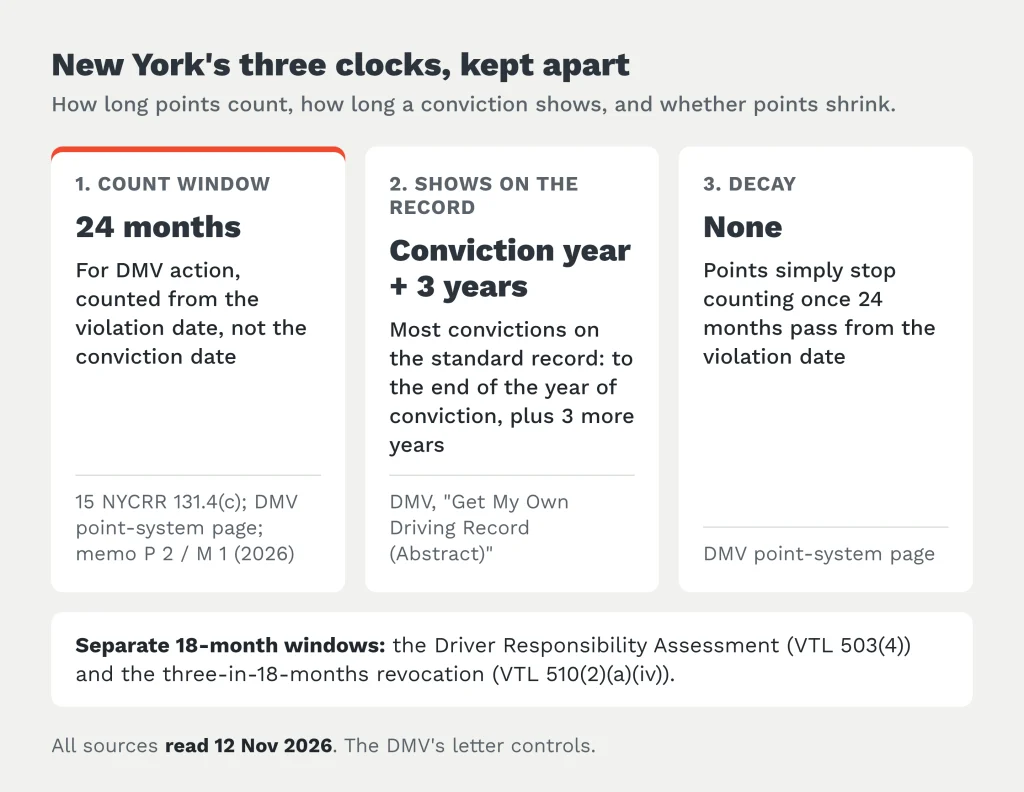
Three different clocks, kept apart (more on each in how long points stay on your record):
| Clock | New York’s rule | Source, read 12 Nov 2026 |
|---|---|---|
| Count window (for DMV action) | 24 months, counted from the violation date, not the conviction date | 15 NYCRR 131.4(c); DMV point-system page; memo P 2 / M 1 (2026) |
| How long it shows on the standard record | Most convictions and crashes until the end of the year of the conviction or crash plus 3 more years; most suspensions and revocations 4 years after they end; chemical test refusals 5 years from the suspension; DWAI 10 years and DWI 15 years from conviction | DMV, “Get My Own Driving Record (Abstract)” |
| Decay | None. Points simply stop counting once 24 months pass from the violation date | DMV point-system page |
The DMV’s page adds that points stay on the record “as long as the conviction remains on your record and may be used by your insurance company to increase premiums.” A “lifetime” abstract shows everything DMV still holds, whatever the retention rules. A separate 18-month window applies to the assessment (VTL 503(4)) and to the three-in-18-months revocation (VTL 510(2)(a)(iv)).
What a course can do
New York’s course is the Point and Insurance Reduction Program, PIRP, also called the defensive driving course. It doesn’t dismiss the ticket or hide the conviction. Rule 131.5 (read 12 November 2026):
- On completion, DMV “shall reduce a total of up to four points,” counted only against violations “which occurred prior to, and within 18 months preceding, the completion of such course” (131.5(a)).
- The credit “will not affect any suspension or revocation action which has already been placed in effect” (131.5(a)).
- “No person can receive a point reduction more than once in any 18-month period” (131.5(b)). Taking the course is voluntary (131.5(c)).
The DMV’s PIRP page (read 12 November 2026) adds that the tickets and points stay on the record, the reduction can’t take the total below zero or be banked against future tickets, it doesn’t change a hearing already scheduled, and the course sponsor reports completion to DMV within 10 weeks. The rule doesn’t say how the 4-point credit interacts with the 9-speeding-point line; the DMV’s letter controls there. On insurance, New York’s Insurance Law requires insurers’ rate plans to give “an actuarially appropriate reduction in premium charges” for three years after an approved course (Ins. Law 2336(a)(1), revision 29 May 2026, read 12 November 2026); the statute sets no percentage.
SR-22: New York has none
You may read that New York uses an “Article 6 certificate” in place of an SR-22. We checked that against the statute, and it isn’t what the text says. New York’s proof-of-financial-responsibility sections sit in Article 7 of the Vehicle and Traffic Law, the Motor Vehicle Safety Responsibility Act, and VTL 346 (revision 22 September 2014, read 12 November 2026) says: “Notwithstanding any other provision of law, no person, on and after February first, nineteen hundred fifty-seven, shall be required to file or maintain proof of financial responsibility pursuant to this article.” In the text we read, no New York rule requires an SR-22-type filing for points, a suspension or a DWI conviction, so there is no filing term to count.
What New York does instead is require insurance on every registered vehicle and act when it ends. VTL 318 (revision 27 April 2018, read 12 November 2026):
- When insurance on a registered vehicle (other than a motorcycle and a few listed vehicle types) ends, DMV “shall suspend the registration of such vehicle and the driver’s license of the registrant” (318(1)(a)), unless the plates were surrendered before the insurance ended (318(1)(c)); DMV need not suspend for a gap of not more than seven days (318(1)(e)).
- The registration suspension lasts until the plates are surrendered and then for as long again as the vehicle was uninsured (318(1-a)(a)). If the plates aren’t surrendered or new insurance obtained within 90 days, DMV “shall suspend the driver’s license” for the same period (318(1-a)(e)).
- Instead, the order can be ended by paying a civil penalty of $8 a day for days 1 to 30 without insurance, $10 a day for days 31 to 60 and $12 a day for days 61 to 90, once in any 36-month period and only within the 90-day limits (318(1-a)(b)).
- An owner who drove or let the vehicle be driven without insurance has the registration and license revoked, with no new license for one year from the revocation (318(2)); the same one-year rule applies to another driver who knew it was uninsured, unless that driver had an operator’s policy (318(3)).
If another state has told you to keep an SR-22 there, that duty comes from that state’s law; the SR-22 and FR-44 period lookup shows each state’s filing term as written.
Age and license type
New drivers face fixed suspensions that don’t depend on points (VTL 510-b and 510-c, revision 9 October 2015, read 12 November 2026):
| License | What the statute says | Section |
|---|---|---|
| Probationary license (other than DJ or MJ), the first six months after issue | “Shall be suspended, for a period of sixty days” on the first conviction for speeding, following too closely (1129), a speed contest (1182), DWAI (1192(1)) or reckless driving (1212), or on the second conviction for any other traffic violation, where the violation was committed during the probationary period; the statute ties this to the violation date, so a conviction entered after the six months can still count. A license restored or issued after such a suspension is probationary again for six months, and a qualifying conviction for a violation committed in those six months means revocation, with no new license for at least six months (510-b(4) applies 510(6)(a)) | 510-b(1)-(4); 501(4); 510(6)(a) |
| Class DJ or MJ junior permit or license | Suspended for 60 days on a conviction or finding of one “serious traffic violation” (including speeding 10 mph or more over, reckless driving, leaving the scene, a speed contest, a stop-sign or school-bus violation) or a second conviction for any other traffic violation, where the violation was committed while the holder had the DJ or MJ permit or license; revoked for 60 days for a qualifying violation committed within six months after restoration | 510-c(1), (2) |
| Probationary or junior, phone or texting (1225-c, 1225-d) | A 120-day suspension; a second conviction for a violation committed within six months after the license or permit is restored (or, for a probationary license, issued) means revocation, with no new license for at least one year | 510(2)(b)(xvi), (xvii); 510(2)(a)(xii), (xiii); 510(6)(n) |
CDL and CLP holders. Federal rules apply on top of New York’s. A conviction for speeding 15 mph or more over is a “serious traffic violation”; a second conviction for any combination of serious traffic violations, in separate incidents within three years, means a 60-day disqualification from driving a commercial motor vehicle and a third 120 days, and in a personal vehicle these count only if the conviction leads to a suspension, revocation or cancellation of the license (49 CFR 383.51(c); eCFR up to date as of 9 November 2026, read 12 November 2026). States may not mask, defer or divert a CDL or CLP holder’s conviction in any vehicle (49 CFR 384.226), so a CDL or CLP holder’s New York traffic conviction (other than parking, weight or vehicle defect violations) must appear on the CDLIS driver record. A CDL holder who drives a commercial motor vehicle must tell the employer in writing within 30 days of a conviction in any vehicle, other than parking (49 CFR 383.31); the separate duty to report out-of-state convictions to the licensing state ended on 22 July 2026 (91 FR 37047). See CDL traffic tickets.
Out-of-state tickets
- A New York driver ticketed elsewhere. The DMV’s point-system page (read 12 November 2026) says points are not added for a conviction in another state or country, “unless the violation occurred in Canada”; convictions from Canadian provinces covered by New York’s reciprocal agreement carry the same points and effect as New York ones, and its assessment page names Quebec and Ontario. Points aside, a conviction a compact state reports for an offense listed in the compact is treated as a New York conviction for DMV action under VTL 510 (510(4)(b)).
- Not answering a ticket in another state. VTL 510(4)(a) lets DMV suspend a license when a holder doesn’t answer a moving-violation summons from a state in the compact, until the person answers that court. The DMV’s tickets page (read 12 November 2026) says the license “will be suspended” for an unanswered moving violation “in any state except Alaska, California, Michigan, Montana, Oregon, or Wisconsin” (the statute itself says “may be suspended”). AAMVA’s member chart (April 2026) also shows Virginia leaving the Nonresident Violator Compact in 2019; the DMV’s list doesn’t mention it.
- A non-resident ticketed in New York. Where a conviction would require a mandatory revocation or suspension for a New York licensee, the non-resident’s privilege to drive in New York is revoked or suspended the same way (510(2)(c)). The home state decides what happens to the home license.
Failure to appear and unpaid fines
- Courts (tickets not handled by the Traffic Violations Bureau). When a court reports that a person didn’t appear within 60 days of the return date on a traffic ticket (not parking), DMV “may suspend” the license until the court reports that the person appeared, paid, entered an installment plan, or the charge was dismissed or ended in acquittal. The suspension takes effect no less than 30 days after the first notice, with at least two notices sent 15 days apart (VTL 510(4-a)(a)). The same applies when a local traffic and parking violations agency reports a failure to appear (510(4-a)(c)).
- New York City tickets. Non-criminal moving tickets in the five boroughs go to the DMV’s Traffic Violations Bureau. If a ticket isn’t answered, the commissioner may suspend the license until the person answers, pays or enters an installment plan, or the charge ends (VTL 226(3)(a)). Not answering is treated as an admission; before entering that order and a fine, DMV must mail a notice saying they can be avoided by pleading or appearing within 30 days (226(3)(b)).
- Ending the suspension. These suspensions last until a $70 termination fee is paid to the court or tribunal, with a cap of $400 per court for all such suspensions resolved there (VTL 503(2)(j-1), read 12 November 2026).
- Unpaid fines alone. In 510(4-a)(a) and 226(3) we found no ground for suspending a driver’s license just because a fine is unpaid. The exceptions we found in the text read: 227(4)(a) allows a license suspension pending payment of a penalty for vehicle size and weight charges under VTL 385; 510(2)(a)(ix) requires revocation where a person convicted of abandoning a vehicle (VTL 1224) fails to pay the fine, except where New York City’s environmental control board decided the case; and for a registered owner who wasn’t driving, 510(4-a)(b) lets DMV suspend the vehicle’s registration, or the owner’s privilege of operating any vehicle the owner owns, over an unpaid court fine on a size and weight (385), registration (401) or 511-a charge (227(4)(a) does the same for a VTL 385 penalty). An unpaid Driver Responsibility Assessment does lead to suspension (503(4)(d)).
Checking points and getting a license back
- Points and status. The DMV’s license status check and the point system page. A driving record abstract costs $7 online through MyDMV or $10 at a DMV office (DMV abstract page, read 12 November 2026).
- Suspensions. DMV mails an order. A definite suspension ends when its period ends and the suspension termination fee is paid; an indefinite one ends only when the step named on the order is done (DMV, suspensions and revocations and termination fee pages, read 12 November 2026). The general suspension termination fee in the statute is $50; it doesn’t apply to a temporary suspension pending a hearing or to an indefinite suspension that ends when the required act is done (VTL 503(2)(j), revision 6 January 2023, read 12 November 2026). The order states what is owed.
- Revocations. The license is cancelled. After the revocation period, DMV approval is usually needed to apply again, and DMV may require tests, a reapplication fee and a driver civil penalty (same DMV page).
- Tickets themselves. The DMV’s Traffic Tickets in New York State page (official) is where New York City Traffic Violations Bureau tickets are answered; tickets from anywhere else in the state go to the city, town, village or county court on the ticket.
When people usually involve a lawyer
Most New York tickets are traffic infractions, which VTL 155 says are “not a crime.” Some charges are crimes: reckless driving is a misdemeanor (VTL 1212), and the DMV’s suspensions page says that since 1 November 2024 driving with five or more suspensions or revocations in effect, imposed on at least five separate dates, is aggravated unlicensed operation in the first degree, a class E felony. People often involve a lawyer for a criminal charge, a DMV persistent-violator hearing (the notice gives the date), a ticket that would be a third speeding or misdemeanor violation within 18 months, or a CDL holder’s ticket. The New York courts’ CourtHelp explains court procedure for people without a lawyer, and Find a Court lists local courts. The New York State Bar Association runs its own Lawyer Referral Service.
The points checker
The points and suspension checker adds up New York points by violation date (for violations from 16 February 2026) and shows each 131.4 line with the entered total beside it.
Your next step
Start with the paper you have. A ticket says which court or the Traffic Violations Bureau handles it and by when to answer; a DMV letter or order says what DMV has decided, from when, and what ends it. Then check your status and points on the DMV’s own pages above, and use CourtHelp for the court’s procedure and forms. Neither the points table nor our checker can see a pending conviction, an out-of-state record not yet reported, or a hearing outcome: the letter does.
Fact-check note. Statutes and rules checked on 12 November 2026: 15 NYCRR 131.2-131.5 on the online NYCRR (govt.westlaw.com/nycrr), “current through September 30, 2025”, re-read the same day in a copy of the same text; Vehicle and Traffic Law sections 155, 226, 227, 318, 346, 501, 503, 510, 510-b, 510-c, 1180, 1212, 1224 and 1809 on nysenate.gov, at the revision dates shown there; Insurance Law 2336; DMV memo P 2 / M 1 (2026); the DMV’s point-system, PIRP, Driver Responsibility Assessment, abstract, suspension and tickets pages; 49 CFR 383.31, 383.51 and 384.226 on the eCFR (up to date as of 9 November 2026); 91 FR 37047. New York’s point rules are rechecked every three months.
Sources
- 15 NYCRR Part 131 (Point System), Department of State online NYCRR, current through 30 Sep 2025
- NY DMV memo P 2 / M 1 (2026): amended 131.3 and 131.4
- NY Vehicle and Traffic Law 510
- NY Vehicle and Traffic Law 510-b
- NY Vehicle and Traffic Law 510-c
- NY Vehicle and Traffic Law 503
- NY Vehicle and Traffic Law 346
- NY Vehicle and Traffic Law 318
- NY Vehicle and Traffic Law 226
- NY Vehicle and Traffic Law 227
- NY Vehicle and Traffic Law 155
- NY Vehicle and Traffic Law 1180
- NY Vehicle and Traffic Law 1212
- NY Vehicle and Traffic Law 1224
- NY Vehicle and Traffic Law 1809
- NY Vehicle and Traffic Law 501
- NY Insurance Law 2336
- NY DMV: The New York State Driver Point System
- NY DMV: Point and Insurance Reduction Program
- NY DMV: Driver Responsibility Assessment
- NY DMV: Get My Own Driving Record (Abstract)
- NY DMV: Suspensions and Revocations
- NY DMV: Traffic Tickets in New York State
- 49 CFR 383.51 (eCFR)
- 49 CFR 384.226 (eCFR)
- 49 CFR 383.31 (eCFR)
- 91 FR 37047, Removal of Self-Reporting Requirement